
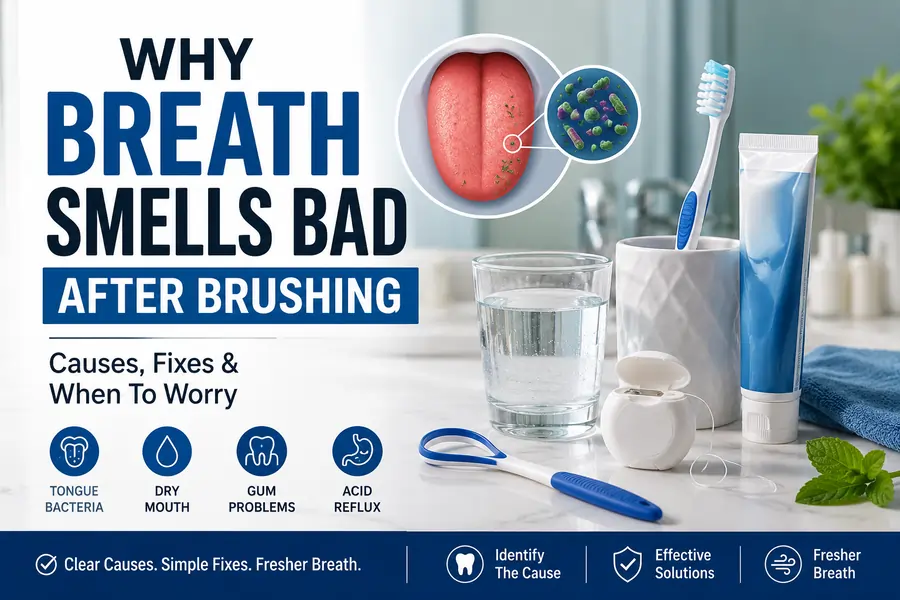
Breath can still smell bad after brushing because the odour often comes from areas your toothbrush does not clean well, including the tongue, gums, spaces between teeth, tonsils, dry mouth, sinus drainage or reflux.
Brushing is essential, but it mainly cleans tooth surfaces. If the smell comes from tongue bacteria, trapped food, gum inflammation, low saliva flow or throat-related causes, the odour can return quickly even after brushing twice a day.
Questions This Guide Answers
- Why does my breath smell bad even after brushing?
- I brush my teeth twice a day but my breath still smells. Why?
- Why does my breath smell bad even after brushing and flossing?
- Why does my breath smell 10 minutes after brushing?
- Why does my breath smell no matter what I do?
- Can tongue bacteria cause bad breath?
- Why does my floss smell bad?
- Can oral probiotics help bad breath?
Brush Twice But Still Smells
After Brushing And Flossing
Smells Soon After Brushing
Main Causes
What To Do
Oral Microbiome
FAQ
Quick Diagnosis: What Your Bad Breath Pattern May Mean
The timing and smell pattern can give useful clues about the cause of bad breath after brushing.
Use this table as a starting point, not a diagnosis. Persistent bad breath should be checked by a dentist, especially if it comes with bleeding gums, pain, swelling, tooth sensitivity or a constant bad taste.
| What You Notice | Possible Cause | Better Next Step |
|---|---|---|
| Breath smells bad 10–30 minutes after brushing | Tongue bacteria, gumline bacteria, dry mouth or trapped food | Clean tongue, floss carefully, hydrate and check gums |
| Breath smells bad even after brushing and flossing | Tonsil stones, dry mouth, sinus drainage, reflux, cavities or gum pockets | Check tongue, throat symptoms and dental warning signs |
| Breath smells worse in the morning | Lower saliva flow, mouth breathing, tongue coating or dry mouth | Hydration, nasal breathing support and tongue cleaning |
| Floss smells bad after use | Food debris or bacteria between teeth | Daily flossing, interdental brushes and dental cleaning |
| Bad breath with bleeding gums | Gum inflammation or gum disease | Book a dental check |
| Bad breath with sour taste or burping | Reflux or throat irritation | Speak with a healthcare professional |
| Bad breath with white lumps near tonsils | Tonsil stones | Dental or medical review if recurring |
I Brush My Teeth Twice A Day But My Breath Still Smells. Why?
Your breath can still smell after brushing twice a day because brushing does not clean every odour source in the mouth.
A toothbrush cleans the visible surfaces of the teeth. It does not fully clean the back of the tongue, the spaces between teeth, gum pockets, tonsil crevices or the throat.
That is why someone can brush morning and night but still feel like their breath smells bad throughout the day.
The issue is not always that you are brushing badly. Often, the problem is that the odour is coming from a place brushing does not reach.
The Most Common Missed Areas
- Back of the tongue: textured surface that traps bacteria and debris.
- Between teeth: food particles can remain after brushing.
- Under the gumline: bacteria can collect where a toothbrush cannot clean deeply.
- Tonsils: stones or trapped debris can create strong odour.
- Dry mouth: low saliva allows odour-causing bacteria to build faster.
Why Does My Breath Smell Bad Even After Brushing And Flossing?
If breath smells bad after brushing and flossing, the cause may be tongue coating, dry mouth, gum disease, tonsil stones, sinus drainage, reflux or tooth decay.
Brushing and flossing are important, but they do not solve every cause of bad breath.
If you already brush and floss daily, look at the clues.
A coated tongue points toward tongue bacteria. A sticky mouth points toward dry mouth. Bleeding gums suggest gum inflammation. A sour taste may suggest reflux. White lumps near the tonsils may suggest tonsil stones.
Why Does My Breath Smell Bad 10 Minutes After Brushing?
Breath that smells bad soon after brushing usually means the odour source was not removed.
This often happens when the smell comes from the tongue, gumline, tonsils, dry mouth or food trapped between teeth.
Toothpaste can temporarily cover odour with mint flavour. Once that flavour fades, the underlying smell returns.
This is why stronger toothpaste or more mouthwash may not solve the problem. The better approach is to identify the source of the odour.
| If It Returns Quickly | Likely Reason | What To Try First |
|---|---|---|
| Bad smell after coffee | Dry mouth and coffee residue | Drink water after coffee and clean tongue |
| Bad smell after meals | Food trapped between teeth | Floss or use interdental brushes |
| Bad smell with white tongue | Tongue coating | Gentle tongue scraper |
| Bad smell with bleeding gums | Gum inflammation | Dentist or hygienist appointment |
| Bad smell with throat taste | Tonsil stones, post-nasal drip or reflux | Check throat and medical symptoms |
Main Causes Of Bad Breath After Brushing
The main causes of bad breath after brushing are tongue bacteria, dry mouth, trapped food, gum disease, cavities, tonsil stones, sinus drainage, reflux, smoking and strong-smelling foods.
The most useful question is not “Which toothpaste should I use?” It is “Where is the smell coming from?”
Tongue Bacteria
The back of the tongue can trap bacteria, dead cells and food residue. This is one of the most common reasons breath smells bad even when teeth are brushed.
Dry Mouth
Saliva helps clear bacteria and food particles. When saliva flow drops, odour can build up quickly.
Food Between Teeth
Brushing does not always remove food from tight spaces. If floss smells bad, trapped debris may be part of the problem.
Gum Problems
Gum inflammation and gum disease can cause persistent bad breath because bacteria collect around and below the gumline.
Tonsil Stones
Tonsil stones can smell very strong because they contain bacteria, debris and hardened material in the tonsils.
Reflux Or Sinus Drainage
Post-nasal drip, throat irritation and reflux can affect breath even when the teeth are clean.
Can Bad Breath Come From The Tongue?
Yes, bad breath often comes from the tongue, especially the back of the tongue.
The tongue surface is not smooth. It has grooves and texture that can hold bacteria, food residue and dead cells. These bacteria can produce unpleasant-smelling compounds.
This is why brushing only the teeth may not be enough.
A tongue scraper can help, but it should be used gently. Aggressive scraping can irritate the tongue and make the mouth feel worse.
Signs Tongue Bacteria May Be Involved
- White or yellow coating on the tongue.
- Bad breath that returns quickly after brushing.
- Morning breath that feels stronger than normal.
- Bad taste on the back of the tongue.
- Breath that smells worse after coffee or dry mouth.
Can Dry Mouth Cause Bad Breath After Brushing?
Yes, dry mouth can cause bad breath after brushing because saliva helps wash away bacteria, acids and food particles.
When saliva flow is low, bacteria and debris stay in the mouth longer. This can make breath smell bad even when you brush regularly.
Dry mouth can be linked to dehydration, mouth breathing, nasal congestion, caffeine, alcohol, smoking, stress, some medications or certain health conditions.
Why Does My Floss Smell Bad?
Floss can smell bad when it removes trapped food, plaque or bacteria from between the teeth.
This does not always mean something serious is wrong. But if floss smells bad every day in the same area, it may point to a problem between those teeth.
Possible reasons include food packing, plaque buildup, gum inflammation, a cavity, a leaking filling or a gap that traps debris.
If one area consistently smells bad despite daily flossing, ask a dentist to check it.
Can Gum Disease Cause Bad Breath?
Yes, gum disease can cause persistent bad breath because bacteria collect around and below the gumline.
This type of odour often does not go away with toothpaste because the bacteria are sitting deeper than a toothbrush can reach.
Common warning signs include:
- Bleeding when brushing or flossing.
- Swollen or tender gums.
- Gum recession.
- Loose teeth.
- A constant bad taste.
- Bad breath that returns soon after cleaning.
If these signs are present, a dental check is more important than changing toothpaste.
Why Does My Breath Smell Like Poop Even After Brushing?
Breath that smells like poop can happen when strong odour-producing bacteria are present in the mouth, throat or digestive system.
In many cases, the smell is still oral or throat-related rather than truly coming from the stomach.
Possible causes include heavy tongue coating, gum disease, tooth decay, tonsil stones, dry mouth, sinus drainage or reflux. A bowel-like smell can feel alarming, but the source is often bacteria breaking down trapped material.
Why Mouthwash Does Not Always Fix Bad Breath
Mouthwash can temporarily improve taste and freshness, but it may not remove the actual source of bad breath.
If the smell comes from tongue coating, gum pockets, tonsil stones, dry mouth, reflux or tooth decay, mouthwash may only cover the odour for a short time.
Some mouthwashes may also feel drying for certain users, especially if used too often or if the mouth is already dry.
A minty feeling is not the same as solving the cause.
What To Do If Your Breath Still Smells After Brushing
If your breath still smells after brushing, focus on the tongue, spaces between teeth, saliva flow, gum health and possible throat or reflux causes.
Start with the simplest changes first.
| Step | Why It Helps | When To Use It |
|---|---|---|
| Clean the tongue gently | Removes tongue coating and bacteria | White tongue, morning breath, quick return of odour |
| Floss or use interdental brushes | Removes food and bacteria between teeth | Bad floss smell, food trapping, odour after meals |
| Drink more water | Supports saliva flow | Dry mouth, coffee breath, morning breath |
| Check your gums | Looks for gum inflammation or gum disease | Bleeding, swelling, bad taste, loose teeth |
| Check tonsils and throat symptoms | Identifies tonsil stones or post-nasal drip clues | Bad taste in throat, white lumps, mucus |
| Review reflux symptoms | Identifies non-mouth causes | Sour taste, burping, heartburn, odour after meals |
How The Oral Microbiome Affects Bad Breath
The oral microbiome affects breath because the balance of bacteria in the mouth influences tongue coating, plaque, gum health and odour production.
A healthy mouth is not bacteria-free. It contains many microorganisms that interact with saliva, teeth, gums, the tongue and food.
Bad breath can happen when the mouth environment favours bacteria that produce stronger odours. This can be influenced by dry mouth, poor flossing, frequent sugar exposure, smoking, gum inflammation and low saliva flow.
For a deeper explanation, read our guide on what the oral microbiome is.
Do Oral Probiotics Help With Bad Breath?
Oral probiotics may help support oral microbiome balance, but they are not a universal fix for bad breath.
They may be more relevant when bad breath appears connected to oral bacteria, tongue coating or microbiome balance. They are less likely to solve bad breath caused by untreated cavities, gum disease, tonsil stones, severe dry mouth or reflux.
Before trying a product, it helps to understand how oral probiotics work and where their limits are.
What Most People Get Wrong About Bad Breath
Most people assume bad breath means they need stronger toothpaste, but the bigger issue is usually the location of the odour source.
If the smell comes from the tongue, gumline, between teeth, tonsils, saliva changes or reflux, toothpaste alone may not solve it.
Common Mistakes
- Only brushing the teeth and ignoring the tongue.
- Using mouthwash to cover odour without finding the cause.
- Skipping flossing because the teeth look clean.
- Ignoring bleeding gums.
- Assuming all bad breath comes from the stomach.
- Trying supplements before checking for dental problems.
When To See A Dentist About Bad Breath
You should see a dentist if bad breath lasts longer than two weeks despite brushing, flossing and tongue cleaning, or if it comes with bleeding gums, pain, swelling, loose teeth, tooth sensitivity or a constant bad taste.
A dentist can check for plaque buildup, gum disease, cavities, dry mouth, infection, dental appliance issues and areas that are hard to clean at home.
If the dentist does not find an oral cause, they may suggest checking for sinus problems, reflux, medication-related dry mouth or other health conditions.
FAQ
Why does my breath smell bad even after brushing twice a day?
Your breath may still smell bad after brushing twice a day if the cause is on the tongue, between the teeth, below the gumline, in the tonsils, in the throat or related to dry mouth. Brushing teeth is important, but it does not clean every odour source.
I brush and floss every day but my breath stinks. Why?
If you brush and floss every day but your breath still smells, the cause may be tongue coating, dry mouth, gum pockets, tonsil stones, reflux, sinus drainage or tooth decay. If the smell persists, a dental check is the safest next step.
Why does my breath smell bad 10 minutes after brushing?
Breath can smell bad shortly after brushing when toothpaste temporarily masks the odour but does not remove the source. Common sources include tongue bacteria, trapped food, gumline bacteria and dry mouth.
Why does my breath smell no matter what I do?
Breath that smells no matter what you do may involve a deeper dental, gum, dry mouth, tonsil, sinus or reflux-related cause. If brushing, flossing and tongue cleaning do not help, see a dentist first.
Can bad breath come from the tongue?
Yes, bad breath can come from the tongue. The back of the tongue can trap bacteria, food residue and dead cells that produce unpleasant odours.
Why does my floss smell bad?
Floss can smell bad when it removes bacteria, plaque or food debris from between teeth. If one area smells bad repeatedly, ask a dentist to check for food trapping, gum problems or decay.
Can dry mouth cause bad breath after brushing?
Yes, dry mouth can cause bad breath after brushing. Saliva helps clean the mouth naturally, so low saliva flow can allow odour to return quickly.
Can gum disease cause bad breath?
Yes, gum disease can cause persistent bad breath. Bacteria can collect around and below the gumline, especially when gums bleed, swell or feel tender.
Why does my breath smell like poop after brushing?
A poop-like breath smell can come from strong odour-producing bacteria in the mouth, tongue, gums, tonsils or throat. Less commonly, reflux or digestive issues may contribute. Persistent or severe odour should be checked professionally.
Can oral probiotics stop bad breath?
Oral probiotics may support oral microbiome balance, but they do not treat every cause of bad breath. They are unlikely to solve bad breath caused by untreated cavities, gum disease, tonsil stones, reflux or severe dry mouth.
Looking For An Oral Probiotic?
If you’ve improved your brushing, flossing, tongue cleaning and hydration but your breath still smells bad, the next step may be understanding the oral microbiome rather than simply trying another toothpaste or mouthwash.
Oral probiotics are designed to support the balance of beneficial bacteria inside the mouth. While they are not a treatment for gum disease, cavities, tonsil stones or reflux, some products are formulated to support fresh breath, healthy gums and overall oral microbiome balance when used alongside good oral hygiene.
Compare The Best Oral Probiotics
Not every oral probiotic contains the same bacterial strains or focuses on the same oral health goals. We compared the leading products based on ingredients, scientific evidence, formulation quality and overall value.
| Product | Best For | Learn More |
|---|---|---|
| GumAktiv | Bad breath, gum support and oral microbiome balance | Read Review → |
| ProDentim | Daily oral microbiome support and fresh breath | Read Review → |
| DentiCore | Enamel support, teeth and gum health | Read Review → |
Remember: Oral probiotics should complement good oral hygiene, not replace it. If your bad breath is caused by untreated gum disease, tooth decay, dry mouth, tonsil stones or another medical condition, addressing the underlying cause is the most important first step.
Final Takeaway
Breath can smell bad after brushing because the cause is often not on the tooth surface alone.
Tongue bacteria, dry mouth, trapped food, gum disease, tonsil stones, reflux, sinus drainage and cavities can all make odour return quickly.
Start with the basics: clean the tongue gently, floss daily, stay hydrated, check your gums and see a dentist if the problem persists.
Once dental and hygiene basics are covered, oral microbiome support may be worth considering, but it should complement proper oral care rather than replace it.
Sources
- National Institute of Dental and Craniofacial Research: Dry Mouth
- National Institute of Dental and Craniofacial Research: Gum Disease
- Mayo Clinic: Bad Breath Symptoms and Causes
- Cleveland Clinic: Bad Breath
- Healthdirect Australia: Halitosis
