
Instead of asking only, “How do I kill more bacteria?” people are asking, “How do I support a healthier balance of bacteria inside my mouth?”
That shift matters because your mouth is not supposed to be sterile. It contains a living ecosystem known as the oral microbiome.
When that ecosystem is balanced, it may support fresher breath, healthier gums, and a more comfortable oral environment. When it becomes disrupted, some people notice issues such as bad breath, plaque buildup, gum irritation, or freshness that disappears quickly after brushing.
Key Takeaway
Oral probiotics may help support oral microbiome balance, fresh-breath routines, and gum wellness for some people, but they are not a guaranteed cure for bad breath or dental problems.
The best way to think about them is as a possible support tool alongside brushing, flossing, tongue cleaning, hydration, and professional dental care.
What Are Oral Probiotics?
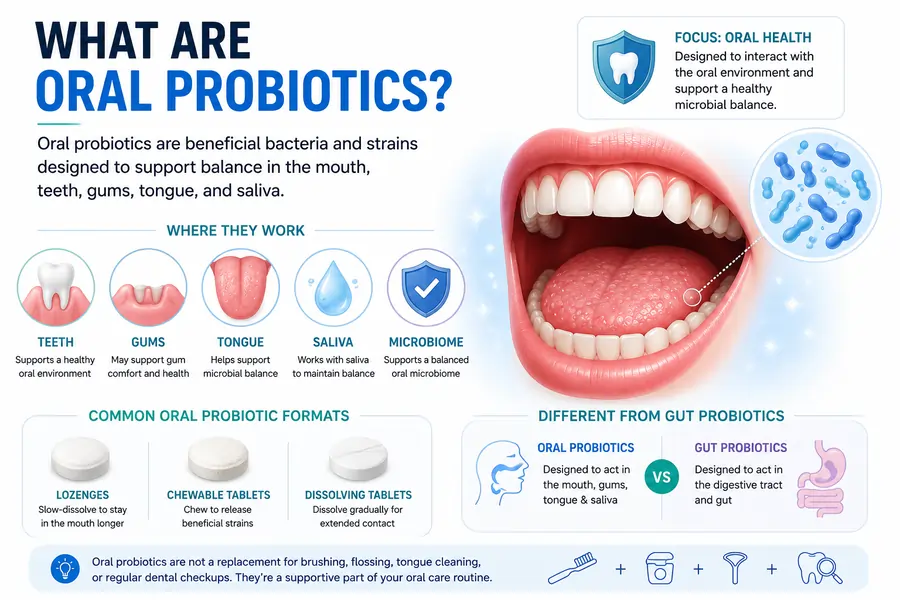
Oral probiotics are probiotic supplements designed to interact with the mouth, teeth, gums, tongue, and saliva rather than only the digestive tract.
Most people already understand gut probiotics. They usually come in capsules, powders, yogurts, or fermented foods and are marketed for digestive health.
Oral probiotics are different because they are usually designed to spend more time in the mouth. They may come as chewable tablets, lozenges, dissolvable tablets, or gums. The idea is to let beneficial bacterial strains interact with the oral environment before being swallowed.
| Type | Main Area of Focus | Common Format |
|---|---|---|
| Gut probiotics | Digestive tract and gut microbiome | Capsules, powders, yogurt, fermented foods |
| Oral probiotics | Mouth, tongue, gums, saliva, oral microbiome | Lozenges, chewables, dissolving tablets |
The Simple Difference
Gut probiotics are usually swallowed quickly. Oral probiotics are usually designed to stay in contact with the mouth for longer, which is why chewable or dissolvable formats are common.
How Do Oral Probiotics Work?
Oral probiotics are intended to support a healthier microbial balance inside the mouth by introducing specific beneficial bacterial strains.
The mouth contains many bacterial communities. Some are associated with oral health. Others may contribute to odor, plaque, gum irritation, or other problems when they become too dominant.
Oral probiotics are based on the idea that adding selected beneficial strains may help influence this microbial environment.
They are not meant to “scrub” the teeth like toothpaste or “rinse” the mouth like mouthwash. Their role is different.
Toothpaste
Helps clean tooth surfaces and remove plaque during brushing.
Floss
Removes debris and plaque from areas between teeth.
Mouthwash
May freshen breath or reduce bacteria depending on the formula.
Oral Probiotics
Focus on supporting microbial balance inside the oral environment.
What Does Research Say About Oral Probiotics?
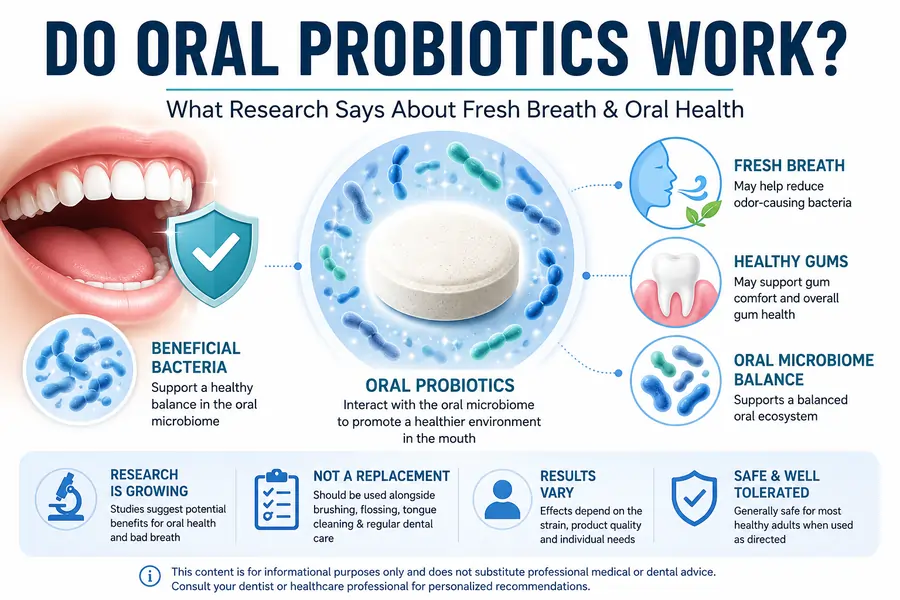
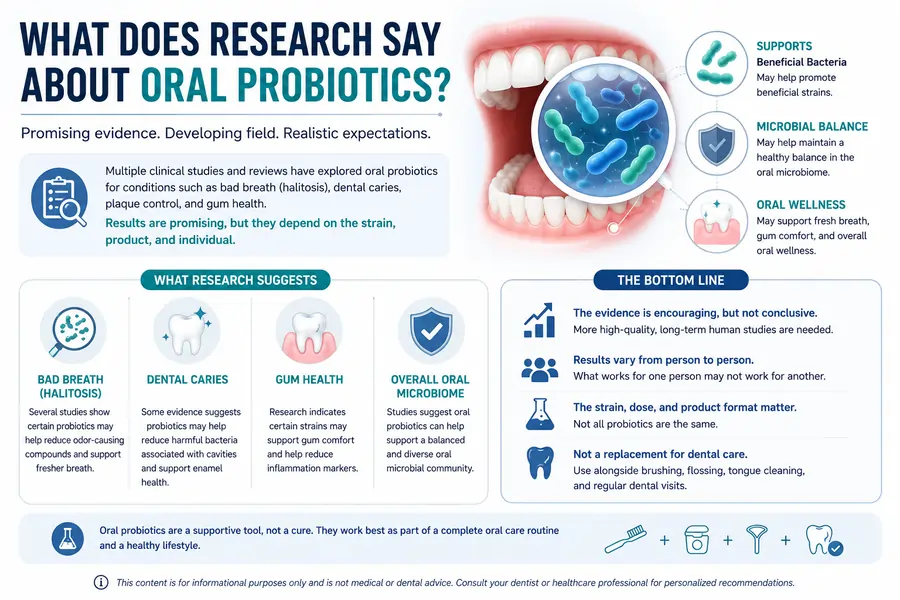
Research on oral probiotics is promising, but it is still developing. The strongest position is cautious optimism, not guaranteed results.
Several reviews and clinical studies have explored probiotic use for oral health, including halitosis, dental caries, and periodontal health. Some studies suggest potential benefits, especially for bad breath and oral microbial balance, but researchers also note that results depend heavily on the specific strain, dose, product format, and individual oral environment.
A good way to think about the evidence is this:
| Question | Current Practical Answer |
|---|---|
| Do oral probiotics have research behind them? | Yes, especially around oral bacteria, halitosis, and microbial balance. |
| Are all oral probiotic products proven? | No. Product quality, strain selection, and claims vary widely. |
| Can they replace dental care? | No. They should be considered supportive, not a replacement. |
| Are results guaranteed? | No. Individual results can vary. |
Can Oral Probiotics Help With Bad Breath?
Oral probiotics may help some people with bad breath by supporting microbial balance, but bad breath has many possible causes.
This is where expectations matter.
If your bad breath is caused mainly by tongue bacteria, dry mouth, trapped food, gum issues, tonsil stones, reflux, or untreated dental disease, the solution depends on the source.
That is why we recommend reading our guide on bad breath after brushing first if you are not sure where the odor is coming from.
For people whose breath concerns seem connected to bacterial balance, tongue coating, or freshness that fades quickly after brushing, oral probiotics may be worth learning about.
Which Probiotic Strains Are Used for Oral Health?
Common oral probiotic discussions often include strains from Lactobacillus, Streptococcus salivarius, Weissella, and Bifidobacterium groups, but the exact strain matters.
Some oral probiotic products are built around one strain. Others include several. The most important thing is not how many strains are listed, but whether the strains make sense for oral use.
| Strain Group | Why It Appears in Oral Health Discussions |
|---|---|
| Lactobacillus strains | Often studied in relation to oral bacteria, gum health, and microbial balance. |
| Streptococcus salivarius | Frequently discussed in relation to the mouth, throat, and breath freshness. |
| Weissella strains | Studied in some halitosis-related research. |
| Bifidobacterium strains | More commonly associated with gut probiotics but sometimes included in oral wellness formulas. |
Who Might Consider Oral Probiotics?
Oral probiotics may be worth considering for adults who already maintain basic oral hygiene but want additional support for oral freshness and microbiome balance.
They may make sense for someone who:
- Brushes and flosses but still feels unsure about breath freshness
- Wants to support the oral microbiome
- Uses mouthwash but finds freshness temporary
- Is interested in oral wellness beyond toothpaste
- Understands that results vary
They may not be the right first step for someone with:
- Tooth pain
- Bleeding gums
- Swelling
- Pus
- Loose teeth
- Untreated dental problems
What Should You Look For in an Oral Probiotic?
A good oral probiotic should clearly list its strains, serving instructions, format, and intended oral-health use.
Not all probiotic supplements are designed for the mouth. If a capsule is swallowed immediately, it may not interact with the oral environment in the same way as a lozenge or chewable.
| Feature | Why It Matters |
|---|---|
| Oral-friendly format | Lozenges and chewables stay in the mouth longer. |
| Clearly named strains | Specific strains matter more than vague probiotic claims. |
| Realistic claims | Avoid products promising cures or guaranteed results. |
| Transparent label | Ingredients and serving details should be easy to find. |
| Good routine fit | The product should be easy to use consistently. |
Want to Compare a Real Product?
We reviewed ProDentim as part of our oral health cluster to explain its formula, positioning, pros, cons, and who it may suit.
Can Oral Probiotics Replace Brushing or Mouthwash?
No. Oral probiotics should not replace brushing, flossing, tongue cleaning, dental checkups, or professional care.
This is one of the most important points in the article.
Oral probiotics are not a shortcut around hygiene. They are a possible support layer.
A realistic oral routine may include:
Brushing
Cleans tooth surfaces and helps remove plaque.
Flossing
Reaches areas where food and plaque collect between teeth.
Tongue Cleaning
Helps reduce buildup on one of the most common odor sources.
Oral Probiotics
May support microbial balance as part of a broader routine.
How Long Do Oral Probiotics Take to Work?
There is no universal timeline because results depend on the product, strain, routine, and the reason someone is using oral probiotics.
Some people may notice changes in freshness or oral comfort within weeks. Others may notice little difference. If the underlying issue is gum disease, decay, reflux, tonsil stones, or dry mouth, an oral probiotic alone may not address the real cause.
Do Oral Probiotics Actually Work?
Oral probiotics appear promising for some areas of oral wellness, especially microbial balance and breath-related concerns, but they are not magic pills.
The most honest answer is:
Oral probiotics may work for some people, depending on the strain, product quality, oral health status, and the cause of the problem they are trying to address.
That answer may not be as exciting as a supplement ad, but it is much more useful.
For The Average Body reader, the real value is understanding where oral probiotics fit:
- They fit after you understand the oral microbiome.
- They fit after you check basic hygiene habits.
- They fit after you consider tongue cleaning, dry mouth, and gum health.
- They fit before comparing products like ProDentim or other oral probiotic supplements.
If you want the product-level comparison next, our upcoming guide to the best oral probiotics will organize the category more clearly.
Final Thoughts
Oral probiotics are not a replacement for dental care, but they are one of the more interesting developments in modern oral wellness.
The reason is simple: they match the way oral health conversations are changing.
Instead of treating the mouth like a battlefield where every bacterium must be destroyed, oral probiotics are part of a broader conversation about balance, microbial diversity, and the oral environment.
For someone struggling with bad breath that keeps returning, that idea can feel refreshing.
But the best approach is still grounded and practical.
Clean your tongue. Floss. Stay hydrated. See a dentist when symptoms persist. Understand your oral microbiome. Then consider whether oral probiotics make sense as an additional support tool.
Bottom Line
Oral probiotics may support oral microbiome balance and fresh-breath routines for some people, but they work best as part of a complete oral care strategy, not as a replacement for basic hygiene or professional dental care.
Related Reading
Start with our guide to the oral microbiome if you want to understand the ecosystem oral probiotics are designed to support.
If your main concern is odor returning after brushing, read why breath can still smell bad after brushing.
If you are comparing products, see our ProDentim review.
Frequently Asked Questions
Do oral probiotics actually work?
Oral probiotics may support oral microbiome balance and fresh-breath routines for some people, but results vary based on the strain, product quality, routine, and underlying oral health issues.
Are oral probiotics the same as gut probiotics?
No. Gut probiotics are usually designed for the digestive tract, while oral probiotics are designed to interact with the mouth, tongue, gums, saliva, and oral microbiome.
Can oral probiotics cure bad breath?
No. Oral probiotics should not be described as a cure. Bad breath can have many causes including tongue coating, dry mouth, gum disease, reflux, tonsil stones, and dental problems.
Should I use oral probiotics instead of mouthwash?
Not necessarily. Mouthwash and oral probiotics have different purposes. Mouthwash may provide freshness or bacterial reduction, while oral probiotics focus on microbial balance.
What is the best form of oral probiotic?
Lozenges, chewables, or dissolving tablets may make more sense for oral use because they stay in the mouth longer than capsules swallowed immediately.
Are oral probiotics safe?
Many healthy adults tolerate probiotics well, but people who are pregnant, nursing, immunocompromised, taking medication, or dealing with dental symptoms should consult a healthcare professional first.
Can oral probiotics replace brushing?
No. Oral probiotics should not replace brushing, flossing, tongue cleaning, dental checkups, or professional treatment.
