
Gut health supplements may help support digestion, bowel regularity, the gut microbiome and certain digestive symptoms, but their effectiveness depends on the ingredients used and the reason they are being taken.
No supplement works for every digestive issue. A product designed for constipation may not help someone whose main concern is bloating, and a probiotic may not address low fibre intake.
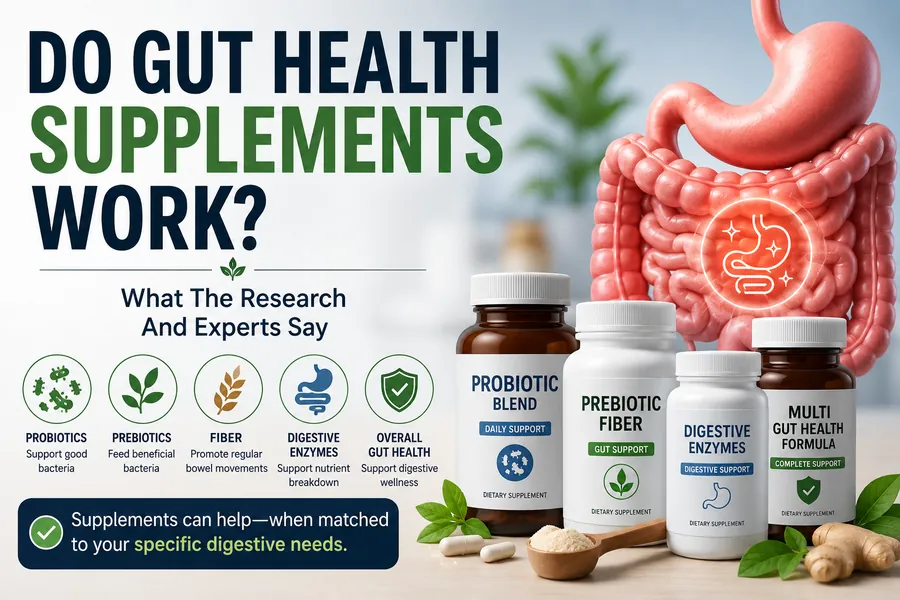
Some gut health supplements can be useful when matched to a specific digestive need. Common ingredients include probiotics, prebiotics, fibre and digestive enzymes. The best results usually occur when supplements support healthy dietary and lifestyle habits rather than replace them.
Key Takeaways
- Gut health supplements are not all the same.
- Different ingredients target different digestive concerns.
- Probiotics, prebiotics, fibre and digestive enzymes work in different ways.
- Research supports some ingredients more strongly than others.
- The underlying cause of symptoms matters more than the supplement label.
- Healthy diet and lifestyle habits remain the foundation of digestive health.
In This Guide
What Are Gut Health Supplements?
Gut health supplements are products designed to support digestive function, bowel regularity, gut bacteria or nutrient digestion.
The term “gut health supplement” covers a wide range of products.
Some focus on probiotics.
Others focus on fibre, digestive enzymes or prebiotics.
Many modern formulas combine multiple ingredients into a single supplement.
This is one reason consumers often become confused when comparing products.
Two supplements may both be marketed for gut health while containing completely different ingredients.
Key Gut Health Terms Explained
| Term | Meaning |
|---|---|
| Gut Health | The overall function and wellbeing of the digestive system. |
| Gut Microbiome | The community of microorganisms living in the digestive tract. |
| Probiotic | Live microorganisms intended to support the gut microbiome. |
| Prebiotic | A type of fibre that feeds beneficial gut bacteria. |
| Digestive Enzyme | A compound that helps break down food during digestion. |
| Dietary Fibre | Plant material that supports bowel function and digestive health. |
Why Do People Take Gut Health Supplements?
People use gut health supplements for many different reasons.
| Goal | Common Supplement Type |
|---|---|
| Support bowel regularity | Fibre supplements |
| Support the gut microbiome | Probiotics |
| Feed beneficial bacteria | Prebiotics |
| Support digestion | Digestive enzymes |
| General digestive support | Multi-ingredient formulas |
Not everyone takes gut supplements because of symptoms.
Many people use them as part of a broader digestive wellness routine.
Types Of Gut Health Supplements
1. Probiotics
Probiotics contain live microorganisms intended to support the gut microbiome.
Different probiotic strains perform different functions.
This means that not all probiotic supplements are identical.
Common probiotic genera include:
- Lactobacillus
- Bifidobacterium
- Saccharomyces
Many people incorrectly assume that a higher probiotic count automatically means a better product.
The specific strains often matter more than the number displayed on the label.
2. Prebiotics
Prebiotics are fibres that feed beneficial gut bacteria.
Unlike probiotics, prebiotics are not live microorganisms.
Instead, they provide fuel that may help support microbial activity.
Common prebiotic ingredients include:
- Inulin
- Fructooligosaccharides (FOS)
- Galactooligosaccharides (GOS)
3. Fibre Supplements
Fibre supplements are commonly used to support bowel regularity and digestive function.
Popular examples include:
- Psyllium husk
- Glucomannan
- Apple pectin
- Oat fibre
Many gut health supplements contain fibre because low fibre intake is common in modern diets.
4. Digestive Enzymes
Digestive enzymes help break down proteins, fats and carbohydrates during digestion.
Examples include:
- Protease
- Lipase
- Amylase
Digestive enzymes are often included in supplements designed to support meal digestion.
5. Multi-Ingredient Gut Health Formulas
Many modern gut supplements combine probiotics, prebiotics, fibre and plant-based ingredients into a single formula.
Examples often include ingredients such as:
- Psyllium
- Aloe vera
- Apple pectin
- Flaxseed
- Probiotic strains
Products such as SynoGut, GutOptim, DigestSync and DigestiStart fall into this broader category.
How Do Gut Health Supplements Work?
Gut health supplements work by supporting one or more digestive processes.
| Supplement Type | Primary Function |
|---|---|
| Probiotics | Support the gut microbiome. |
| Prebiotics | Feed beneficial bacteria. |
| Fibre | Support bowel regularity and stool formation. |
| Digestive Enzymes | Support food breakdown during digestion. |
| Multi-Ingredient Formulas | Target multiple digestive functions simultaneously. |
The important point is that different digestive concerns may require different approaches.
A person looking to increase fibre intake may not need the same supplement as someone looking for probiotic support.
What Does The Research Say About Gut Health Supplements?
The research does not support the idea that every gut supplement works equally well.
Some ingredients have significantly more research behind them than others.
For example:
| Ingredient Category | Research Availability |
|---|---|
| Psyllium | Extensively studied |
| Probiotics | Large body of research |
| Prebiotics | Growing evidence base |
| Digestive enzymes | Moderate research support |
| Proprietary blends | Varies by formula |
Research is usually conducted on specific ingredients or strains rather than entire supplement categories.
This is why evaluating ingredient quality is often more important than evaluating marketing claims.
When May Gut Health Supplements Help?
Gut health supplements may be most useful when they address a specific digestive need rather than being used as a general solution for every gut-related symptom.
This is where many people see the biggest benefit.
Instead of choosing a supplement because it is popular, they choose one that matches their primary concern.
| Situation | Supplement Type Often Used | Why |
|---|---|---|
| Low fibre intake | Fibre supplement | Supports stool bulk and bowel regularity. |
| Support for gut bacteria | Probiotic | Provides beneficial bacterial strains. |
| Support for beneficial bacteria | Prebiotic | Provides fuel for microbial activity. |
| Digestive support | Digestive enzymes | Helps break down food components. |
| Multiple digestive concerns | Multi-ingredient formula | Targets several digestive functions simultaneously. |
The most effective supplement is often the one that best matches the user’s situation.
When Gut Health Supplements Probably Won’t Help
Gut supplements are not a substitute for addressing the underlying cause of digestive symptoms.
This is one of the most important points people miss.
A supplement may not provide meaningful results if the real issue involves:
- Very low fibre intake
- Poor hydration
- Chronic sleep deprivation
- Medication side effects
- An undiagnosed medical condition
- Consistently poor dietary habits
In these situations, the supplement is attempting to compensate for a larger problem.
The underlying issue still needs attention.
Reality check: A probiotic cannot fully compensate for a poor diet, and a fibre supplement cannot completely replace a consistently low-fibre eating pattern.
What Most People Get Wrong About Gut Health Supplements
Many people assume that the most expensive supplement, the highest probiotic count or the longest ingredient list automatically means better results.
That assumption is often incorrect.
Some common misconceptions include:
- More ingredients always means better results.
- More probiotic strains are always better.
- Higher CFU counts guarantee effectiveness.
- Every digestive symptom requires a probiotic.
- Gut supplements work immediately.
In reality, the relationship between ingredients and outcomes is more complicated.
The right supplement depends on the individual, the goal and the formulation.
Problem → Supplement Type Guide
Different digestive concerns often align with different supplement categories.
| Digestive Concern | Common Supplement Category |
|---|---|
| Low fibre intake | Fibre supplements |
| Support bowel regularity | Fibre-based formulas |
| Gut microbiome support | Probiotics |
| Beneficial bacteria support | Prebiotics |
| Meal digestion support | Digestive enzymes |
| Multiple digestive goals | Multi-ingredient gut health formulas |
This table should not be viewed as medical advice.
It simply illustrates how supplement categories are commonly used.
How To Choose A Gut Health Supplement
The best gut health supplement is usually the one that matches your primary digestive goal.
Before comparing products, ask yourself:
- Am I trying to increase fibre intake?
- Am I looking for probiotic support?
- Am I interested in digestive enzymes?
- Do I want a multi-ingredient formula?
- Am I addressing a specific symptom or general digestive wellness?
Answering these questions often narrows the field significantly.
Many consumers skip this step and immediately compare brands, which makes choosing a supplement much more difficult.
How To Evaluate A Gut Health Supplement
Evaluating the ingredient profile is often more useful than evaluating marketing claims.
| Factor | Why It Matters |
|---|---|
| Ingredient quality | Determines what the supplement actually contains. |
| Ingredient purpose | Shows whether the formula matches your goal. |
| Dosage transparency | Allows consumers to assess the formulation. |
| Research availability | Provides evidence supporting ingredients. |
| Formula design | Shows how ingredients work together. |
Consumers often spend too much time comparing brands and not enough time understanding ingredients.
Are Expensive Gut Health Supplements Better?
Not necessarily.
Price alone does not determine quality.
Some premium products contain unique ingredients, higher-quality sourcing or more comprehensive formulas.
Others simply invest more heavily in branding and marketing.
The best approach is to evaluate:
- Ingredients
- Formula design
- Transparency
- Research support
- Value for money
Cost should be considered alongside quality rather than used as a shortcut for quality.
Scientific Research Related To Common Gut Health Ingredients
Research is stronger for some gut health ingredients than others.
| Ingredient Category | Research Support |
|---|---|
| Psyllium | Extensive research for bowel regularity. |
| Probiotic strains | Large body of strain-specific research. |
| Prebiotics | Growing evidence base. |
| Digestive enzymes | Moderate evidence depending on enzyme type. |
| Multi-ingredient blends | Evidence varies significantly by formulation. |
One of the biggest mistakes consumers make is assuming research on one probiotic strain automatically applies to all probiotic strains.
Research is often strain-specific.
This is why ingredient-level evaluation is important.
Related Gut Health Supplements Covered On The Average Body
If you’re comparing products, these reviews may help.
Each formula takes a slightly different approach to digestive support.
Fast Facts About Gut Health Supplements
- Not all gut supplements work the same way.
- Different ingredients support different digestive functions.
- Research is often ingredient-specific.
- Fibre, probiotics and digestive enzymes serve different purposes.
- The underlying cause of symptoms matters more than marketing claims.
- Diet and lifestyle remain the foundation of digestive health.
Frequently Asked Questions
Do gut health supplements actually work?
Some gut health supplements may support digestive health when their ingredients match a person’s digestive goals and needs.
Are probiotics the same as gut health supplements?
No. Probiotics are one category of gut health supplement. Other categories include prebiotics, fibre supplements and digestive enzymes.
How long do gut health supplements take to work?
The timeframe varies depending on the ingredients, the individual and the reason for use.
Can gut supplements replace a healthy diet?
No. Gut supplements are generally intended to complement healthy dietary and lifestyle habits rather than replace them.
Which type of gut supplement is best?
The best type depends on the individual’s goals, symptoms and digestive needs.
Are all probiotic supplements the same?
No. Different probiotic products contain different strains, combinations and formulations.
Sources
- National Institute of Diabetes and Digestive and Kidney Diseases (NIDDK)
- National Institutes of Health (NIH)
- Cleveland Clinic
- Harvard Health Publishing
- Mayo Clinic
Final Answer: Do Gut Health Supplements Work?
Gut health supplements may help support digestion, bowel regularity, gut bacteria and digestive wellness when the ingredients match the individual’s needs and goals.
However, not all supplements work in the same way.
Probiotics, prebiotics, fibre supplements and digestive enzymes each serve different purposes.
The most effective approach is understanding the problem first and then selecting a supplement designed to address that specific need.
Next step: Explore our guide to the best gut health supplements to compare popular formulas, ingredients and value.
