
Frequent nighttime awakenings can result from stress, irregular sleep schedules, caffeine, alcohol, hormonal changes, environmental disturbances or underlying sleep disorders. While briefly waking between sleep cycles is normal, repeatedly waking up and struggling to fall back asleep can reduce sleep quality and leave you feeling tired the following day.
Falling asleep and staying asleep are two different processes. Some people fall asleep within minutes but wake several times during the night. Others consistently wake around 2 am or 3 am and struggle to return to sleep.
Understanding what regulates sleep and what interrupts it can help identify why these awakenings occur and which changes may help.
Is It Normal to Wake Up During the Night?
Yes. Brief awakenings during the night are a normal part of human sleep. The brain moves through several sleep stages, and short periods of wakefulness can occur between sleep cycles.
According to the National Heart, Lung, and Blood Institute (NHLBI), sleep cycles generally repeat every 80 to 100 minutes, with most people completing four to six cycles each night.
| Sleep Stage | What Happens |
|---|---|
| NREM Stage 1 | The body transitions from wakefulness into light sleep. |
| NREM Stage 2 | Heart rate and body temperature decrease as sleep progresses. |
| NREM Stage 3 | Deep sleep occurs, contributing to physical restoration. |
| REM Sleep | Brain activity increases, and vivid dreaming commonly occurs. |
Most people do not remember every brief awakening. Problems arise when these interruptions become frequent, last for extended periods or affect daytime functioning.
What Controls Your Ability to Stay Asleep?
Two biological processes primarily regulate sleep: the circadian rhythm and homeostatic sleep pressure. Together, they influence when you feel sleepy, when you wake and how sleep is distributed throughout the night.
Circadian Rhythm
The circadian rhythm is the body’s internal timing system that operates on an approximately 24-hour cycle. It responds to environmental signals such as daylight and darkness.
Exposure to light helps regulate alertness, while darkness supports the body’s natural preparation for sleep.
Irregular bedtimes, shift work and bright evening light can interfere with this timing system.
Homeostatic Sleep Pressure
Sleep pressure is the biological need for sleep that increases the longer a person remains awake.
Adenosine, a naturally occurring compound in the body, contributes to this process. As sleep progresses, sleep pressure gradually decreases.
Long daytime naps and caffeine consumption can interfere with the normal relationship between sleep pressure and bedtime.
Melatonin
Melatonin is a hormone produced primarily by the pineal gland in response to the body’s internal clock and surrounding light conditions.
Melatonin levels typically rise during the evening, signalling that biological nighttime is approaching.
However, melatonin primarily helps regulate sleep timing. Frequently waking during the night does not automatically indicate a melatonin deficiency.
The NIH’s explanation of the sleep-wake cycle describes how these biological processes work together to regulate sleep and alertness.
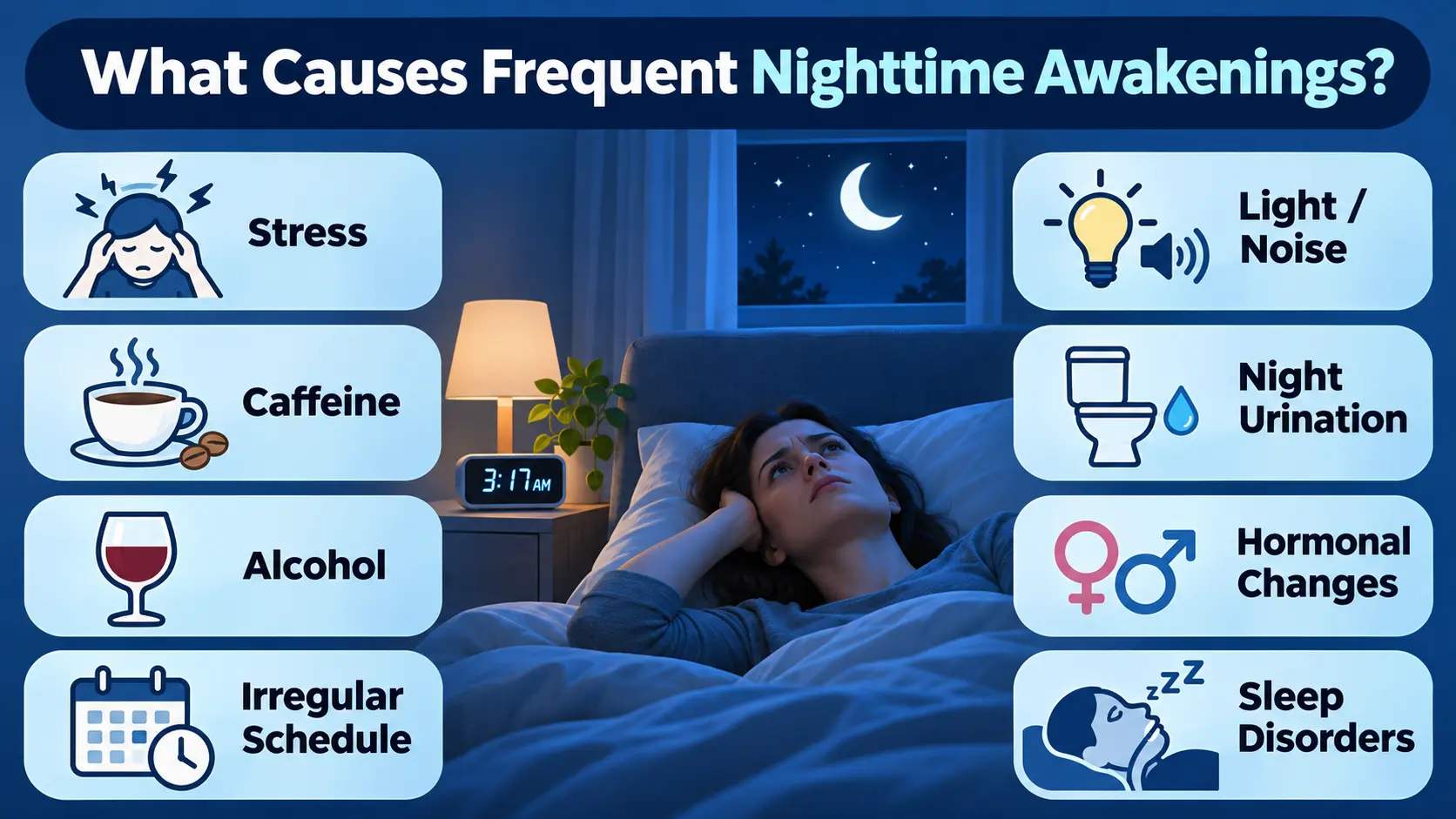
What Causes Frequent Nighttime Awakenings?
Frequent nighttime awakenings can have behavioural, environmental, psychological or medical causes. In many cases, more than one factor contributes to interrupted sleep.
1. Stress and an Overactive Mind
Stress can make it difficult for the body and mind to remain in a relaxed state throughout the night.
Work responsibilities, financial concerns and personal worries may become particularly noticeable when external distractions disappear at bedtime.
Some people fall asleep normally because they are physically tired but struggle to return to sleep after waking and beginning to think about these concerns.
2. Caffeine Consumption
Caffeine temporarily blocks adenosine receptors, reducing feelings of sleepiness.
Because caffeine can remain active in the body for several hours, an afternoon coffee may still affect sleep at night, particularly in people who metabolise caffeine slowly.
Being able to fall asleep after consuming caffeine does not necessarily mean that caffeine is having no effect on sleep quality.
3. Alcohol Consumption
Alcohol may initially make a person feel sleepy, but it can disrupt normal sleep patterns as the body processes it.
This can result in lighter, more fragmented sleep later in the night.
4. Irregular Sleep Schedules
Frequently changing bedtime and waking times can disrupt the body’s internal clock.
For example, someone who wakes at 6 am during the working week but sleeps until 10 am on weekends may experience difficulty maintaining a consistent sleep pattern.
5. Bedroom Temperature, Light and Noise
A bedroom that is too warm, noisy or brightly lit can contribute to nighttime awakenings.
External disturbances may also become more noticeable during lighter stages of sleep.
A cool, dark and quiet bedroom generally provides conditions more suitable for uninterrupted sleep.
6. Frequent Nighttime Urination
Nocturia describes waking during the night to urinate.
Evening fluid consumption, certain medications, bladder conditions, prostate problems and sleep apnea can contribute to nocturia.
It is also possible to wake for another reason and then notice the need to use the bathroom. Identifying which occurs first may help distinguish between different causes.
7. Hormonal Changes
Hormonal changes during perimenopause and menopause can interfere with sleep, particularly when accompanied by hot flashes, night sweats or mood changes.
Age-related changes in sleep patterns may also contribute to more frequent awakenings or earlier waking times.
8. Sleep Disorders and Medical Conditions
Obstructive sleep apnea, restless legs syndrome, chronic pain, acid reflux and insomnia can all interfere with sleep continuity.
Obstructive sleep apnea causes repeated interruptions in breathing during sleep. These interruptions can result in brief awakenings that the person may not remember.
When to investigate further:Frequent awakenings accompanied by loud snoring, gasping for air, morning headaches or excessive daytime sleepiness should be discussed with a healthcare professional. These symptoms may indicate sleep apnea or another sleep disorder.
What Your Nighttime Awakening Pattern May Tell You
The circumstances surrounding an awakening can offer useful clues about what is interrupting sleep, although they cannot establish a medical diagnosis on their own.
| Sleep Pattern | Possible Explanation | What to Investigate |
|---|---|---|
| Waking with racing thoughts | Stress or anxiety | Evening relaxation habits and sources of stress |
| Waking several times to urinate | Nocturia or another medical condition | Fluid intake, medications and bladder health |
| Waking while gasping for air | Possible sleep apnea | Professional sleep assessment |
| Waking feeling hot or sweaty | Room temperature or hormonal changes | Bedroom conditions and menopause symptoms |
| Waking after evening alcohol consumption | Alcohol-related sleep disruption | Alcohol timing and consumption |
| Waking earlier than intended | Body clock changes, insomnia or mood disorders | Sleep timing and associated symptoms |
| Waking tired despite spending eight hours in bed | Fragmented or insufficient sleep | Actual sleep duration and underlying sleep problems |
Why Do I Keep Waking Up at 2 AM or 3 AM?
Consistently waking at 2 am or 3 am may be related to sleep-cycle transitions, declining sleep pressure, stress, environmental disturbances or an established sleep pattern.
As the night progresses, the proportion of time spent in different sleep stages changes. Deep sleep is generally more common during the earlier part of the night, while REM sleep becomes more prominent later.
A person who goes to bed at approximately the same time every evening may therefore experience similar sleep transitions at similar times.
Waking at a particular hour does not establish that a specific organ, hormone or medical condition is responsible.
Does waking at 3 am mean your cortisol is too high?Not necessarily. Cortisol follows a daily biological rhythm and generally increases as the body approaches its normal waking time. However, waking at 3 am alone is not evidence of abnormal cortisol levels.
Why Am I Still Tired After Eight Hours of Sleep?
Spending eight hours in bed does not necessarily mean that you have obtained eight hours of sleep. Sleep continuity, actual sleep duration, sleep timing and underlying health conditions all influence how rested you feel.
Consider two hypothetical examples involving people who both spend eight hours in bed.
Person A
Time in bed: 8 hours
Time spent awake: 15 minutes
Estimated sleep duration: 7 hours and 45 minutes
Sleep efficiency: Approximately 97%
Person B
Time in bed: 8 hours
Time spent awake: 90 minutes
Estimated sleep duration: 6 hours and 30 minutes
Sleep efficiency: Approximately 81%
Although both people spent the same amount of time in bed, Person B obtained substantially less sleep.
Sleep efficiency describes the proportion of time spent in bed that is actually spent sleeping. It is one useful measure of sleep continuity, but it does not capture every aspect of sleep quality.
Persistent morning fatigue can also occur in people who sleep for an adequate duration but have an undiagnosed sleep disorder.
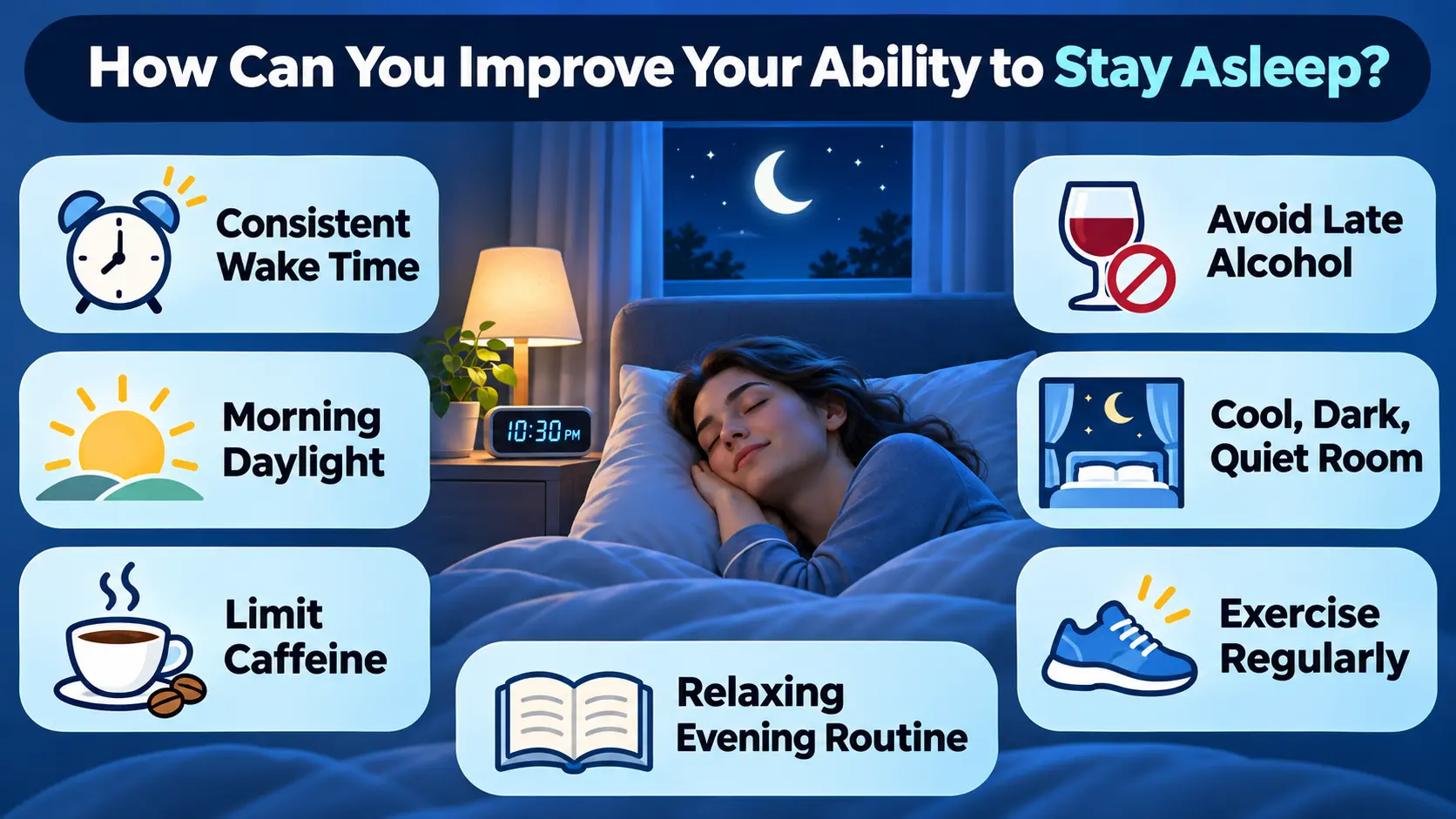
How Can You Improve Your Ability to Stay Asleep?
Improving sleep continuity starts with identifying and reducing the factors that interrupt sleep. Consistent waking times, appropriate light exposure, caffeine management and suitable bedroom conditions are useful starting points.
| Daily Habit | How It May Support Sleep |
|---|---|
| Maintain a consistent waking time | Supports the body’s internal clock. |
| Get natural daylight in the morning | Provides a daytime signal for the circadian rhythm. |
| Reduce afternoon and evening caffeine | Reduces interference with normal sleep pressure. |
| Limit alcohol before bedtime | May reduce alcohol-related sleep fragmentation. |
| Keep the bedroom cool, dark and quiet | Reduces environmental disturbances. |
| Exercise regularly | Supports general health and normal sleep regulation. |
| Establish a relaxing evening routine | Helps reduce stimulation before bedtime. |
These habits are consistent with the NHLBI recommendations for healthy sleep.
What Should You Do When You Wake Up and Cannot Fall Back Asleep?
If you wake during the night and cannot return to sleep, avoid turning the awakening into a source of additional stress.
Repeatedly checking the clock, calculating how much sleep remains and worrying about the following day can increase alertness.
If you remain awake and become frustrated, consider getting out of bed and doing a quiet activity in dim lighting. Return to bed when you feel sleepy again.
Reading a printed book, listening to quiet music or practising slow breathing may be preferable to checking emails, social media or work messages.
What Most People Get Wrong About Interrupted Sleep
One common mistake is assuming that going to bed earlier will compensate for repeatedly waking during the night.
Spending additional time in bed does not necessarily increase actual sleep duration. For someone who already struggles to sleep, it may simply increase the amount of time spent awake in bed.
Another mistake is assuming that every sleep problem requires a supplement that makes the body feel sleepy.
Difficulty falling asleep, difficulty staying asleep and waking too early can have different causes. A product intended to support sleep timing may not address interruptions caused by breathing problems, pain or frequent urination.
How to Identify What Is Interrupting Your Sleep
A sleep diary kept for one to two weeks can help identify recurring patterns that are difficult to notice from individual nights.
Useful information to record includes:
- Bedtime and waking time.
- Estimated time taken to fall asleep.
- Number and duration of nighttime awakenings.
- Caffeine and alcohol consumption.
- Daytime naps.
- Nighttime symptoms such as sweating, discomfort or urination.
- Morning energy levels.
For example, if longer awakenings consistently follow late-afternoon coffee consumption, changing caffeine timing may be a reasonable first step.
If awakenings occur regardless of daily habits and are accompanied by loud snoring or daytime exhaustion, a medical assessment may be more appropriate.
The NIH provides a free sleep diary that can help record these patterns.
When Should You Seek Professional Help for Interrupted Sleep?
Speak with a healthcare professional when nighttime awakenings occur regularly, interfere with daily activities or continue despite changes to sleep habits.
According to the NHLBI criteria for insomnia, sleep difficulties occurring at least three nights per week for three months or longer may indicate chronic insomnia when other diagnostic criteria are met.
Cognitive behavioural therapy for insomnia (CBT-I) is an established first-line treatment for chronic insomnia. It addresses sleep-related thoughts, behaviours and habits that contribute to ongoing difficulties.
A 2021 clinical practice publication from the American Academy of Sleep Medicine strongly recommends multicomponent CBT-I for adults with chronic insomnia.
There is no need to wait three months before seeking help if sleep problems are already affecting everyday life. Avoid driving or operating machinery when excessively sleepy.
Can Sleep Supplements Help You Stay Asleep?
Sleep supplements may support certain aspects of sleep regulation or relaxation, but their usefulness depends on the cause of the sleep problem, the ingredients used and the amount of each ingredient.
Common sleep supplement ingredients include melatonin, magnesium, L-theanine and botanical extracts.
Melatonin
Melatonin supplements are primarily associated with sleep timing and the initiation of sleep.
The National Center for Complementary and Integrative Health (NCCIH) discusses a 2022 research review involving 12 studies and 2,666 participants. Melatonin was associated with improvements in the time taken to fall asleep and daytime sleepiness, but improvements in overall sleep quality and nighttime wakefulness were not established in that review.
Magnesium
Magnesium participates in normal muscle and nervous system function. It is commonly included in supplements intended to support evening relaxation.
However, the NCCIH assessment of magnesium supplements notes that there is insufficient high-quality research to establish their effectiveness for insomnia and other sleep disorders.
L-Theanine and Botanical Ingredients
L-theanine and botanical extracts such as lemon balm are included in some sleep formulations intended to support relaxation before bedtime.
Different formulas contain different ingredients and amounts. Research involving an individual ingredient should not automatically be interpreted as evidence that a finished combination supplement produces the same results.
Before choosing a sleep supplement:Consider whether your main difficulty is falling asleep, staying asleep or waking too early. Discuss supplements with a healthcare professional if you take medications, have an existing medical condition, are pregnant or are breastfeeding.
Frequently Asked Questions
Is waking up twice during the night normal?
Yes. Brief awakenings can occur during normal sleep. The duration of these awakenings and their effect on daytime functioning are more informative than the number alone.
Why do I wake up every two hours?
Waking approximately every two hours may coincide with sleep-cycle transitions. However, stress, environmental disturbances, sleep apnea and other conditions can also cause repeated awakenings.
Can anxiety make you wake up during the night?
Yes. Anxiety can contribute to heightened alertness, nighttime awakenings and difficulty returning to sleep.
Does magnesium help you stay asleep?
Magnesium may support normal nervous system function, but current research is insufficient to establish that magnesium supplementation consistently prevents nighttime awakenings.
Does melatonin stop you from waking up at night?
Not necessarily. Melatonin primarily influences sleep timing, and evidence supporting its effectiveness for maintaining sleep is limited.
Why do I wake up feeling tired even after sleeping all night?
Unrefreshing sleep can result from sleep fragmentation, insufficient sleep duration, sleep apnea, medical conditions or differences between your sleep schedule and biological clock.
Can interrupted sleep affect memory and concentration?
Yes. Insufficient or repeatedly disrupted sleep can affect attention, memory, mood and daytime performance.
Understanding Sleep Support Before Choosing a Supplement
Improving sleep quality involves more than increasing the number of hours spent in bed. Sleep timing, relaxation, sleep continuity and the underlying causes of nighttime awakenings all need consideration.
For adults researching sleep support supplements, some formulations combine melatonin with minerals, amino acids and botanical ingredients intended to support nighttime relaxation and sleep regulation.
One example is Yu Sleep, a liquid sleep supplement containing melatonin alongside magnesium glycinate, L-theanine, GABA, apigenin, lemon balm and other supporting ingredients.
Our Yu Sleep review examines the formula, ingredient amounts, available research, intended benefits, pricing and considerations before purchasing.
This article is for educational purposes and does not replace professional medical advice, diagnosis or treatment.
