
Yu Sleep is a liquid bedtime supplement that combines 0.9 mg melatonin with vitamins B2 and B6 and a seven-ingredient botanical and amino-acid blend.
One bottle of Yu Sleep contains 30 servings when taken as directed. Its main appeal is a measured, convenient nightly routine rather than a large standalone melatonin dose.
The most useful buying checks are the ingredient label, cost per night, medicine interactions and the final checkout terms.
This Yu Sleep review examines what the drops contain, how melatonin and supporting ingredients relate to the sleep-wake cycle, who may prefer a liquid formula, and how the advertised package prices compare.
It also explains what to expect from a nightly routine, how to interpret customer reviews, and when a different sleep solution deserves priority.
The assessment is based on published product information and independent ingredient research, not a personal trial of Yu Sleep.
Affiliate disclosure: The Average Body may earn a commission when readers purchase through links on this page, at no additional cost to them. Product information and prices were reviewed in October 2026 and may change.
Yu Sleep Review: Is It Worth Considering?
Yu Sleep is worth considering for adults who prefer liquid sleep support and want a fixed, low-dose melatonin serving alongside additional bedtime ingredients.
The 2 mL format is simple, and a 30-serving bottle makes the recurring cost easy to estimate. The main trade-off is that seven ingredients share one 637 mg combined blend, so their individual quantities are not shown.
Editorial assessment: 4.8/5 (Excellent). This is an assessment of the published formula, convenience, label disclosure and advertised value. It is not a score for clinical effectiveness or a hands-on customer test.
Best for. Adults who prefer drops to tablets; people building a consistent evening routine; buyers who want melatonin combined with relaxation-oriented ingredients.
Not ideal for. People using medicines that affect serotonin without medical approval; anyone needing a fully itemised dose for every ingredient; people with ongoing sleep symptoms that require medical assessment.
Check Current Yu Sleep Packages
How Does Yu Sleep Work With the Sleep-Wake Cycle?
Yu Sleep brings together a melatonin signal and ingredients associated with bedtime relaxation. The idea is to support two related parts of sleep preparation: recognising that nighttime has arrived and reducing stimulation before bed.
The circadian rhythm is the body’s approximately 24-hour timing system. Melatonin is a hormone involved in signalling biological nighttime.
Sleep onset latency is the time between trying to sleep and falling asleep. Sleep maintenance describes remaining asleep after sleep begins.
These are related, but different outcomes, and one supplement should not be judged as though they are identical.
Yu Sleep’s 0.9 mg melatonin amount is clearly disclosed. A 2024 review of 26 randomised trials found that melatonin dose and administration time influenced sleep onset and total sleep time.
That is a useful reason to take the labelled timing seriously rather than treating more melatonin as automatically better.
The other ingredients broaden the formula beyond melatonin alone. L-theanine is researched for relaxation and sleep quality, while tart cherry and lemon balm have also been studied in connection with sleep.
Their presence helps explain the formulation, although research on individual substances should not be read as a trial of the finished Yu Sleep product.
What Ingredients Are in Yu Sleep?
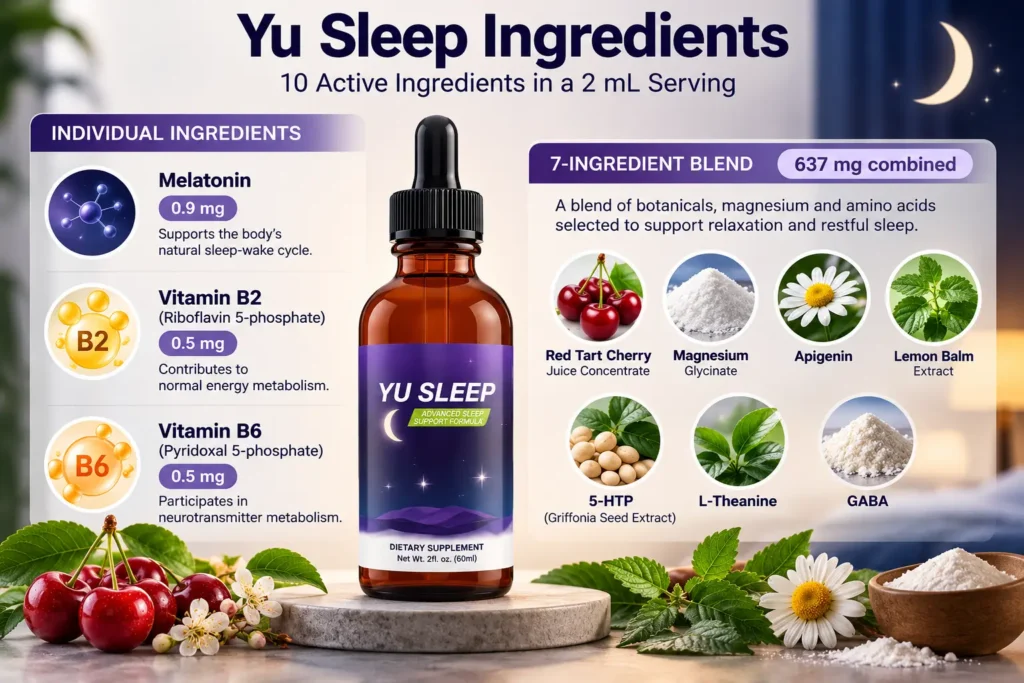
Yu Sleep lists ten active ingredients, with three individual quantities and one combined blend weight. The published Supplement Facts information for a 2 mL serving gives the following breakdown.
| Ingredient or group | Amount per 2 mL serving | Why it is included |
|---|---|---|
| Melatonin | 0.9 mg | Supports the body’s nighttime signal |
| Vitamin B2 (riboflavin 5-phosphate) | 0.5 mg | Contributes to normal energy metabolism |
| Vitamin B6 (pyridoxal 5-phosphate) | 0.5 mg | Participates in neurotransmitter metabolism |
| Seven-ingredient blend | 637 mg combined | Brings together botanicals, magnesium and amino acids associated with relaxation |
The blend contains red tart cherry juice concentrate, magnesium glycinate, apigenin, lemon balm extract, 5-HTP from Griffonia seed extract, L-theanine and GABA.
These are listed as ingredients of a single group rather than seven separate dose lines.
A useful distinction for buyers is ingredient presence versus ingredient dose. A blend can contain several well-known ingredients without containing the same amounts used in published studies.
The 637 mg total is a measure of the combined blend, not 637 mg of each ingredient. That makes the product easiest to judge as a complete formula, rather than as seven separate supplements in one bottle.
What Does Research Say About the Main Yu Sleep Ingredients?
Melatonin and L-theanine provide the clearest human sleep research connections in the listed formula, while other ingredients have more varied evidence.
Looking at the actual study outcomes gives a more practical picture than simply counting ingredients.
Melatonin and Bedtime Timing
Melatonin is a timing signal, not a conventional sedative. It is particularly relevant when the intended bedtime and the body’s internal schedule do not match.
The 0.9 mg amount in Yu Sleep is below many standalone products sold at 3 mg or 5 mg, but a lower amount does not automatically suit every person.
Timing, light exposure and the reason for poor sleep still influence the experience.
L-Theanine and Evening Relaxation
L-theanine is an amino acid from tea that has been investigated for sleep quality and relaxation.
A 2025 systematic review and meta-analysis of human trials reported improvements in several self-reported sleep measures, including sleep quality and the time taken to fall asleep.
The paper does not establish an individual Yu Sleep dose, because that amount sits within the combined blend.
Tart Cherry and Lemon Balm
Tart cherry and lemon balm have plausible roles as supporting bedtime ingredients. Tart cherry contains naturally occurring compounds, including melatonin-related constituents and polyphenols.
A 2025 review reported improvements in some sleep outcomes across seven intervention studies, although methods and servings differed.
Lemon balm, or Melissa officinalis, has been examined in human research on relaxation and sleep quality.
Magnesium Glycinate, Apigenin, 5-HTP and GABA
These ingredients expand the formula toward nervous-system and neurotransmitter functions, but they do different jobs.
Magnesium contributes to normal nerve and muscle function.
Apigenin is a plant flavonoid associated with chamomile.
5-HTP is a precursor involved in serotonin production.
GABA is the principal inhibitory neurotransmitter in the central nervous system, although swallowing GABA is not equivalent to directly changing brain GABA activity.
A 2025 magnesium bisglycinate trial found a modest difference in reported insomnia severity after four weeks at a known magnesium dose.
A 2020 review of oral GABA described much less consistent human sleep evidence. The important comparison is between studied amounts and the label, not between ingredient names alone.
What Can You Expect From Yu Sleep Results?
The most sensible way to assess Yu Sleep is to watch for a more consistent bedtime experience, rather than expect an identical result every night.
Its formulation makes the strongest practical case as part of a regular wind-down routine, especially for readers who prefer drops to multiple separate products.
Consider two common situations. Someone who goes to bed at a different hour each night may get more value from first fixing bedtime and morning light exposure.
Someone with a fairly steady schedule who wants a simple evening supplement may find Yu Sleep easier to incorporate consistently than a collection of separate capsules.
A third situation is repeated waking during the night. That pattern can have causes unrelated to the time it takes to fall asleep, including caffeine, alcohol, breathing-related sleep problems and the bedroom environment.
Melatonin does not make all sleep concerns the same.
For a practical self-check, record bedtime, estimated time to fall asleep, nighttime awakenings, wake time and morning alertness over a consistent period.
Compare nights with similar schedules, rather than using a single unusually good or poor night as the verdict. This is a way to monitor experience, not a clinical test of the product.
How Do You Take Yu Sleep Drops?
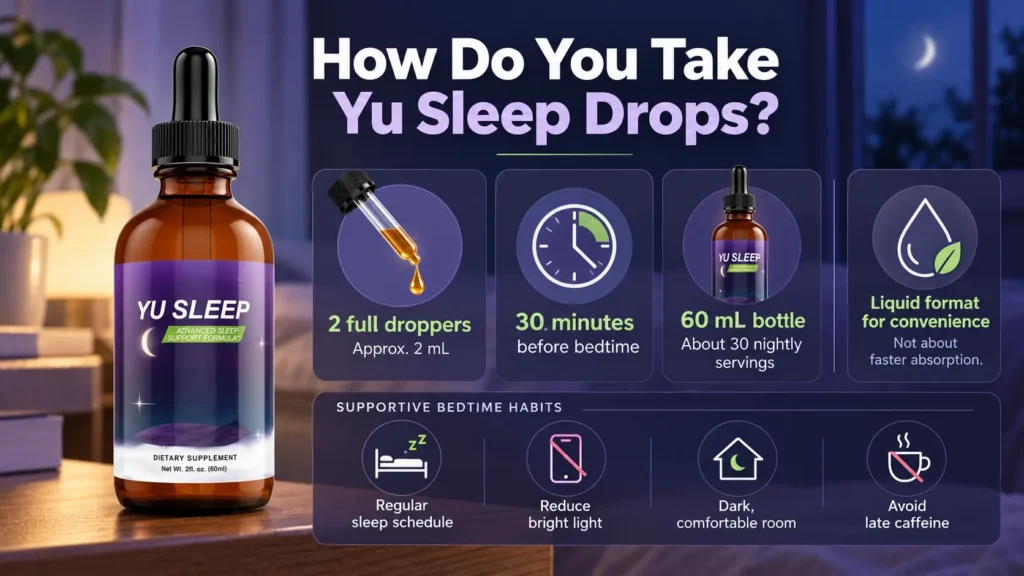
The published Yu Sleep directions specify two full droppers, approximately 2 mL, around 30 minutes before bedtime.
A standard bottle contains 60 mL, which corresponds to roughly 30 nightly servings at the stated amount. Always follow the directions printed on the bottle you received, since packaging and instructions can change.
The best surrounding habits are straightforward. Use a regular sleep schedule, reduce bright light near bedtime, keep the room dark and comfortable, and avoid late caffeine.
These steps support the same sleep-wake timing system that melatonin relates to. The National Heart, Lung, and Blood Institute explains why these habits are useful.
A liquid format offers convenience and avoids swallowing tablets. It does not, by itself, establish faster absorption or better clinical results than capsules.
The reason to choose drops is the format and combined formula, not an assumed speed advantage.
How Much Does Yu Sleep Cost in 2026?
Yu Sleep is advertised at different per-bottle prices depending on package size, with larger bundles carrying a lower nightly cost.
The prices below are examples seen on Yu Sleep promotional order pages in October 2026, expressed in US dollars. The actual seller checkout is the controlling price and may differ.
| Package | Advertised price per bottle | Example package total | Approximate cost per night |
|---|---|---|---|
| One bottle, 30 servings | $69 | $69 | $2.30 |
| Three bottles, 90 servings | $59 | $177 | $1.97 |
| Six bottles, 180 servings | $39 | $234 | $1.30 |
At one serving each night, a single bottle is the smallest upfront purchase.
A larger package lowers the advertised cost per serving but requires more upfront commitment before the buyer knows whether the routine suits them.
Check shipping, taxes, currency conversion, and any extras before payment.
See Yu Sleep pricing and availability
What Do Yu Sleep Customer Reviews Tell Buyers?
Yu Sleep customer reviews are most useful when they describe a specific sleep concern, the length of use and the buying experience.
A short endorsement without context says less than a review that explains whether the person was concerned about falling asleep, nighttime waking or their morning routine.
When reading customer feedback, look for these details. They make it easier to compare another person’s circumstances with your own.
- Sleep goal. Was the reviewer focused on bedtime relaxation, falling asleep or staying asleep?
- Use pattern. Did the person follow the stated serving and a consistent bedtime?
- Time frame. Does the review describe one night or a longer period?
- Purchase experience. Does it discuss delivery, order confirmation or customer support?
- Specificity. Does it explain an actual observation instead of making a broad promise?
The Average Body has not conducted a verified customer survey or a hands-on trial of Yu Sleep, so this article does not assign a customer-star average or present anonymous statements as verified purchases
. Our editorial score assesses the documented product characteristics instead.
Where Can You Buy Yu Sleep and What Should You Check Before Ordering?
The simplest option is to use a current Yu Sleep seller checkout, verify the bottle count, and save the confirmation email.
This is especially useful because online product pages can change prices, bundle descriptions and service terms.
Before submitting payment, confirm the total price, shipping destination, currency, refund period, recurring-payment terms if any, and customer-support contact shown on the order page.
Promotional pages describe a 60-day refund policy, but the actual seller’s conditions should determine the purchase decision.
For buyers searching for Yu Sleep on Amazon or from Australia, UK, Canada or other countries, availability and delivery terms must be confirmed for the specific listing and destination.
A marketplace result does not automatically establish that its seller or formulation is the same as the offer reviewed here. Keep the checkout receipt for any later order or return enquiry.
Is Yu Sleep Safe to Take Every Night?
Yu Sleep requires the same medication and health checks as any supplement containing melatonin and 5-HTP. A convenient serving does not remove the need to consider medicines, underlying conditions and next-morning alertness.
5-HTP deserves particular attention because it affects serotonin production. People taking antidepressants or other medicines that influence serotonin should not combine them with 5-HTP without approval from a qualified clinician. Memorial Sloan Kettering explains these 5-HTP medicine interactions.
People who are pregnant or breastfeeding, people with significant health conditions, and anyone already taking sleep medicines should seek professional advice before use.
Do not drive or operate machinery if drowsy. Keep supplements away from children. Melatonin is generally regarded as reasonably safe for short-term adult use, but long-term safety information is less complete.
Persistent insomnia, loud snoring, breathing pauses during sleep or severe daytime sleepiness deserve medical assessment.
Cognitive behavioural therapy for insomnia (CBT-I) is a standard first-line treatment for chronic insomnia and addresses a different need from a bedtime supplement. The NHLBI insomnia treatment page explains these treatment options.
Yu Sleep vs Melatonin Tablets and Single-Ingredient Supplements
Yu Sleep’s advantage is convenience and formula breadth, while a single-ingredient product makes the specific dose easier to compare with research.
The better option depends on whether the buyer values one combined routine or precise control over each component.
| Buying criterion | Yu Sleep drops | Standalone melatonin | Standalone L-theanine or magnesium |
|---|---|---|---|
| Main purpose | Combined bedtime support | Melatonin timing support | One selected ingredient |
| Format | Liquid drops | Often tablet, capsule or liquid | Often capsule or powder |
| Disclosed Yu Sleep melatonin amount | 0.9 mg | Varies by product | Usually none |
| Dose visibility | Three stated amounts plus a combined blend | Often clearly stated melatonin amount | Often clearly stated individual amount |
| Main buying appeal | One bedtime routine | Simpler, single-ingredient choice | Targeted ingredient choice |
A buyer mainly interested in circadian timing may prefer straightforward melatonin. Someone wanting to avoid melatonin should not choose Yu Sleep, because it contains 0.9 mg per serving.
Someone who prefers a liquid blend with several supporting ingredients may find Yu Sleep more convenient. This distinction is more useful than declaring one form universally superior.
Who Should Consider Yu Sleep, and Who Should Choose Something Else?
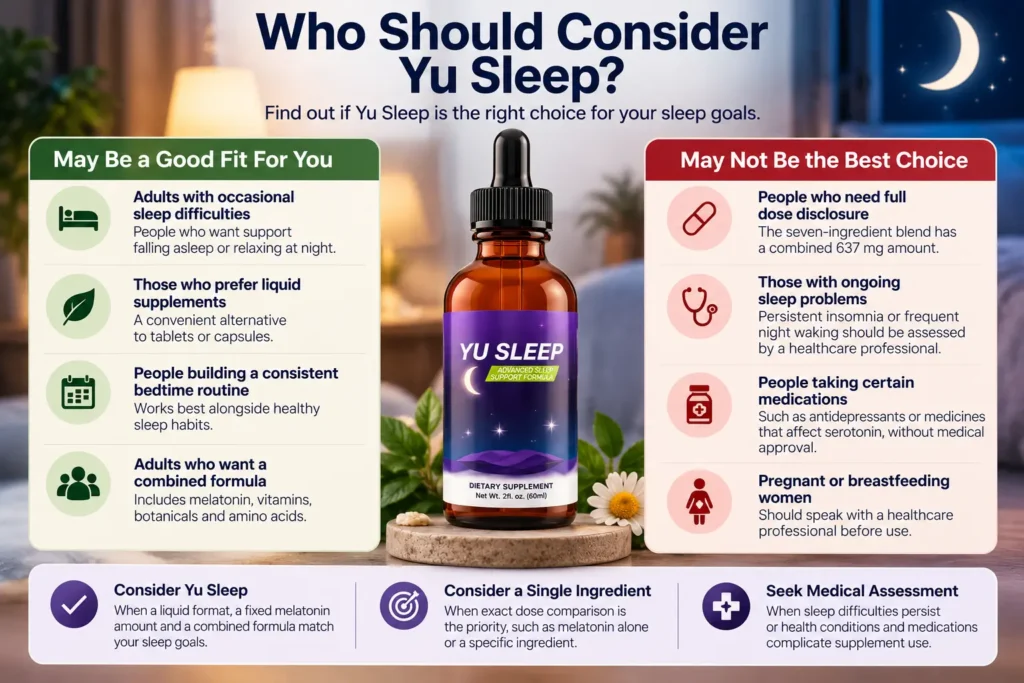
Yu Sleep makes the most sense for adults seeking an easy-to-measure liquid addition to a consistent bedtime routine.
It is a narrower choice for anyone prioritising full per-ingredient dose disclosure or needing treatment for an established sleep disorder.
The decision can be reduced to three practical cases. Choose Yu Sleep to consider when a combined liquid format and fixed melatonin amount match the preference. Choose a single ingredient when exact dose comparison is the priority.
Seek medical assessment first when sleep difficulties persist or medicines and health conditions complicate supplement use.
This is also why the return policy, price per night and label are part of the product evaluation.
Many buyers repurchase sleep support, so the ongoing routine matters more than the first-bottle headline offer.
Frequently Asked Questions About Yu Sleep
These answers cover the main purchase, ingredient and use questions that readers ask before choosing Yu Sleep. Each answer refers to the disclosed formulation and seller terms reviewed in October 2026.
What is Yu Sleep used for?
Yu Sleep is used as a bedtime dietary supplement intended to support relaxation and the normal sleep-wake cycle. It combines melatonin, vitamins, botanicals and amino acids in liquid drops.
Does Yu Sleep contain melatonin?
Yes. The published formula lists 0.9 mg melatonin per 2 mL serving. It is not a melatonin-free supplement.
How many drops of Yu Sleep should you take?
The stated serving is two full droppers, or 2 mL, approximately 30 minutes before bedtime. Follow the label on the actual bottle rather than estimating individual drops.
How long does one Yu Sleep bottle last?
One bottle lasts approximately 30 nights when used at one 2 mL serving per night. The published bottle size is approximately 60 mL.
Is Yu Sleep better than melatonin alone?
Yu Sleep offers a broader combined formula, while standalone melatonin allows a buyer to focus on one stated ingredient and dose. The better choice depends on the sleep goal, medicines and format preference.
Can Yu Sleep help someone who wakes during the night?
Yu Sleep is marketed for general sleep support, but frequent awakenings can have several causes. Tracking the pattern and assessing persistent symptoms is more useful than assuming they all have the same solution.
How much does Yu Sleep cost?
Advertised US package examples range from $39 to $69 per bottle, depending on the quantity purchased. Check the current checkout for the final total, shipping and taxes.
Is Yu Sleep sold on Amazon?
Marketplace availability can change. Confirm the seller, label, delivery details and return terms for any listing before ordering.
Can Yu Sleep be shipped to Australia?
Shipping eligibility depends on the seller’s checkout and applicable local rules. Australian buyers should confirm international delivery and local restrictions before making payment.
Is Yu Sleep suitable for children?
No. This review covers adult use. A child’s sleep concern requires advice from a qualified healthcare professional rather than an adult supplement routine.
Does Yu Sleep replace treatment for chronic insomnia?
No. Yu Sleep is a dietary supplement. Persistent insomnia warrants professional assessment, and CBT-I is an established treatment option.
Is Yu Sleep a liquid supplement?
Yes. It is supplied as liquid drops and measured using the included dropper.
Final Verdict: Should You Buy Yu Sleep?
Yu Sleep is a reasonable option for adults who want liquid sleep support built around 0.9 mg melatonin and complementary bedtime ingredients.
Its clearest strengths are the measured two-dropper serving, the 30-night bottle and the convenience of combining several ingredients in one routine.
The main purchasing consideration is that the seven-ingredient blend shares a total of 637 mg rather than separate doses.
For buyers comparing Yu Sleep reviews, Yu Sleep ingredients, Yu Sleep price and Yu Sleep results, the useful decision is straightforward.
Check that the formula fits existing medicines and health needs, choose a package using the true cost per night, and assess the experience alongside a consistent sleep schedule.
A carefully chosen supplement can be one part of a healthier bedtime routine, but it should never replace appropriate care for persistent sleep problems.
Scientific Sources and Product Information
The sources below support the ingredient, timing and safety information in this review. They should be read as evidence about the listed substances or published label, not as a finished-product clinical trial.
