
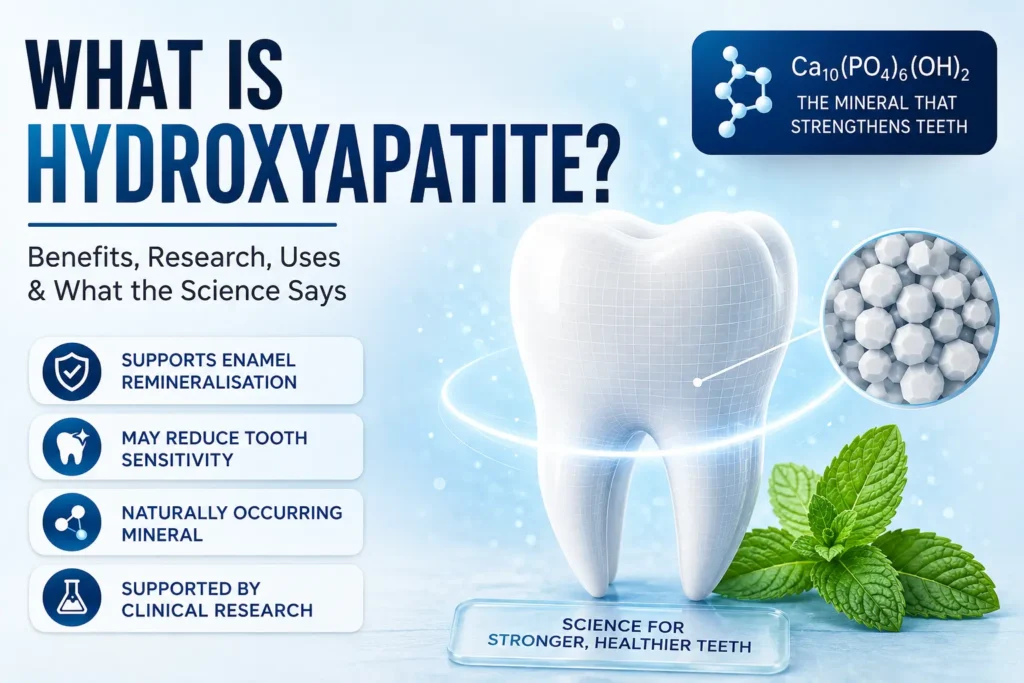
Hydroxyapatite is a naturally occurring mineral made primarily of calcium and phosphate that forms the main structural component of human tooth enamel and bones.
Hydroxyapatite helps give teeth their hardness and strength. It is increasingly used in modern toothpastes and oral health products because laboratory and clinical research suggests it may help support enamel remineralisation, reduce tooth sensitivity and protect teeth from everyday acid exposure.
Quick Facts About Hydroxyapatite
| Attribute | Details |
|---|---|
| Type | Calcium phosphate mineral |
| Main Role | Forms tooth enamel and bone |
| Found Naturally In | Teeth and skeletal tissue |
| Common Uses | Toothpaste, oral care products, dental materials |
| Main Benefit | Supports enamel remineralisation |
| Evidence | Growing clinical evidence |
What Is Hydroxyapatite?
Hydroxyapatite is the mineral that gives teeth their hardness.
Around 95% of tooth enamel consists of hydroxyapatite crystals arranged in an incredibly dense structure. These microscopic crystals protect teeth from chewing forces, temperature changes and the acids produced by bacteria inside the mouth.
Unlike many ingredients added to oral care products, hydroxyapatite is not foreign to the body. It is already the primary mineral naturally present in healthy enamel.
One reason hydroxyapatite has received increasing attention is that it mimics the natural composition of tooth enamel rather than introducing an entirely new chemical compound.
Why is Hydroxyapatite Important?
Every day, your teeth lose tiny amounts of minerals through a process known as demineralisation.
Acidic foods, sugary drinks, plaque bacteria and normal eating gradually remove calcium and phosphate from the enamel surface.
Fortunately, the opposite process, remineralisation, also occurs.
When sufficient calcium, phosphate and saliva are present, minerals can be redeposited onto the enamel, helping maintain its structure.
The Daily Enamel Cycle
| Process | What Happens? |
|---|---|
| Demineralisation | Acids remove minerals from enamel. |
| Remineralisation | Minerals are redeposited back into enamel. |
| Healthy Balance | Enamel remains strong. |
| Unhealthy Balance | Progressive mineral loss may eventually contribute to tooth decay. |
Understanding this balance explains why researchers have become interested in hydroxyapatite-containing oral care products.
Rather than simply cleaning the teeth, these products aim to provide minerals similar to those naturally found in enamel.
How Does Hydroxyapatite Work?
Hydroxyapatite works by supplying calcium and phosphate minerals that can bind to the tooth surface, helping support the natural remineralisation of enamel and reducing the microscopic defects that contribute to tooth sensitivity.
Research suggests hydroxyapatite particles can attach to areas of early enamel mineral loss, where they may help restore surface minerals and protect teeth against everyday acid exposure.
Unlike ingredients that simply clean the teeth, hydroxyapatite is chemically similar to the mineral that naturally makes up human enamel, allowing it to integrate with the tooth surface more effectively.
Laboratory studies suggest these particles may help fill tiny surface irregularities while supporting the natural remineralisation process.
Researchers continue to investigate exactly how these particles interact with enamel under real-world conditions, but several clinical studies have reported encouraging results for reducing sensitivity and supporting enamel.
Potential Functions
- Supports enamel remineralisation.
- Helps smooth microscopic enamel defects.
- May reduce tooth sensitivity.
- Supports everyday enamel protection.
- Works alongside saliva during natural remineralisation.
Hydroxyapatite is not a treatment for existing cavities. Once tooth decay has progressed into a true cavity, professional dental treatment is usually required.
Why Hydroxyapatite Has Become More Popular
Hydroxyapatite has become more popular because growing research suggests it can help support enamel remineralisation and reduce tooth sensitivity using the same mineral that naturally makes up human teeth.
As interest in biomimetic dentistry has increased, many oral care brands have started using hydroxyapatite in toothpastes and supplements as an alternative or complement to traditional enamel-supporting ingredients.
Consumers are also becoming more aware of preventive oral care, leading to greater demand for products that support long-term enamel health rather than simply whitening teeth or masking symptoms.
Instead of focusing only on removing plaque, modern oral care increasingly aims to support the natural biology of the mouth, including enamel, saliva and the oral microbiome.
This broader approach explains why hydroxyapatite now appears in an increasing number of toothpastes and oral health supplements.
Hydroxyapatite is also included in several modern oral health formulations.
For example, our SynaDentix review explains how hydroxyapatite is combined with other ingredients intended to support healthy teeth, gums and overall oral wellness.
What Are The Benefits Of Hydroxyapatite?
Hydroxyapatite may help support enamel remineralisation, reduce tooth sensitivity and strengthen the natural protective surface of the teeth.
Because hydroxyapatite is chemically similar to the mineral naturally found in tooth enamel, it has become one of the most researched ingredients in modern oral care. While research is ongoing, studies suggest it may provide several potential benefits when used as part of a regular oral hygiene routine.
Potential Benefits of Hydroxyapatite
- Supports enamel remineralisation by helping replenish minerals lost through everyday acid exposure.
- May reduce tooth sensitivity by sealing microscopic openings in exposed dentine.
- Helps protect tooth enamel against daily wear and demineralisation.
- May reduce bacterial attachment to the tooth surface, supporting a healthier oral environment.
- Supports smoother enamel surfaces, which may make plaque less likely to accumulate.
- Works with the body’s natural enamel structure because it is chemically similar to the hydroxyapatite already found in healthy teeth.
- Suitable for long-term daily oral care as part of brushing, flossing and regular dental check-ups.
Most of the strongest clinical evidence comes from studies on hydroxyapatite toothpaste rather than dietary supplements. While these findings are encouraging, products containing hydroxyapatite should complement, not replace, good oral hygiene and professional dental care.
Potential Benefits At A Glance
| Potential Benefit | Current Evidence |
|---|---|
| Supports enamel remineralisation | Strong |
| May reduce tooth sensitivity | Strong |
| Supports enamel surface repair | Moderate |
| May reduce bacterial attachment | Emerging |
| Supports overall oral health | Moderate |
What Does The Research Say?
Hydroxyapatite is one of the most extensively studied biomimetic ingredients currently used in oral care products.
Unlike many natural ingredients that rely mainly on traditional use, hydroxyapatite has been evaluated in laboratory studies, clinical trials and systematic reviews.
Most published studies investigate hydroxyapatite toothpaste rather than oral supplements. While the findings are encouraging, results from toothpaste research should not automatically be applied to supplements containing hydroxyapatite.
Enamel Remineralisation
One of hydroxyapatite’s best-supported roles is helping promote enamel remineralisation.
A 2019 systematic review published in Biomimetics concluded that hydroxyapatite demonstrated considerable potential for repairing early enamel lesions and supporting remineralisation.
Researchers suggested that hydroxyapatite particles can integrate with the enamel surface, helping restore mineral content in the early stages of demineralisation.
Research Highlight
- Biomimetics (2019) concluded that hydroxyapatite showed promising evidence for enamel remineralisation and prevention of early carious lesions.
Tooth Sensitivity
Hydroxyapatite has also been widely investigated for dentine hypersensitivity.
Several clinical studies suggest it may help block exposed dentinal tubules, reducing the movement of fluids that trigger pain when consuming hot, cold or sweet foods.
Research Highlight
- A 2023 systematic review found hydroxyapatite toothpaste demonstrated meaningful improvements in dentine hypersensitivity across multiple clinical studies.
Plaque And Oral Bacteria
Researchers are also exploring whether hydroxyapatite influences bacterial attachment.
Instead of killing bacteria directly like some antiseptic mouthwashes, hydroxyapatite appears to work differently by interfering with bacterial adhesion to tooth surfaces.
This area remains under active investigation.
Early Tooth Decay
Hydroxyapatite appears most useful during the earliest stages of enamel mineral loss.
Once a cavity has formed, remineralisation alone is generally insufficient.
Hydroxyapatite should not be viewed as a treatment for established tooth decay. Cavities usually require professional dental treatment.
Hydroxyapatite vs Fluoride
Both hydroxyapatite and fluoride help protect tooth enamel, but they work in different ways and have different levels of clinical evidence.
Fluoride has been used in dentistry for decades and remains the standard recommendation for preventing cavities. Hydroxyapatite is a newer option that has gained attention because it is the same mineral naturally found in human teeth and may help support enamel remineralisation.
Hydroxyapatite vs Fluoride
| Feature | Hydroxyapatite | Fluoride |
|---|---|---|
| Main Function | Supports enamel remineralisation using enamel-like minerals | Strengthens enamel by forming acid-resistant fluorapatite |
| Naturally Found in Teeth | ✅ Yes | ❌ No |
| Scientific Evidence | Strong and growing | Extensive, with decades of clinical research |
| Tooth Sensitivity | May help reduce sensitivity by sealing microscopic dentine tubules | Some fluoride products are formulated for sensitivity relief |
| Early Enamel Repair | Supports remineralisation of early mineral loss | Supports remineralisation and helps prevent further decay |
| Everyday Use | Common in premium toothpastes and some oral supplements | Widely used in toothpaste, mouthwash and community water fluoridation |
Which is better?
Neither ingredient is universally better. Fluoride has the strongest long-term evidence for preventing tooth decay, while hydroxyapatite is attracting growing interest because it closely resembles natural tooth enamel and may support remineralisation and sensitivity reduction. The most suitable choice depends on your oral health needs, personal preferences and your dentist’s recommendations.
What most people get wrong
Many online articles present hydroxyapatite and fluoride as direct competitors. In reality, both aim to support enamel health through different biological mechanisms. Choosing one does not necessarily mean the other is ineffective, and many dental professionals consider both valid options depending on the individual situation.
Practitioner Insight
This comparison is often presented as “Hydroxyapatite versus fluoride.”
In reality, many dental professionals see them as two different approaches to supporting enamel rather than direct competitors. The most appropriate option depends on an individual’s oral health needs, preferences and recommendations from their dental professional.
Nano-Hydroxyapatite vs Hydroxyapatite
Not all hydroxyapatite products use particles of the same size.
Many premium oral care products now use nano-hydroxyapatite because the smaller particles may interact more effectively with microscopic enamel defects.
| Standard Hydroxyapatite | Nano-Hydroxyapatite |
|---|---|
| Larger particles | Much smaller particles |
| Supports enamel surface | May penetrate smaller enamel defects more effectively |
| Common in supplements | Common in premium toothpaste formulations |
Research continues to evaluate whether nano-sized particles provide clinically meaningful advantages over conventional hydroxyapatite.
Is Hydroxyapatite Safe?
Current evidence suggests hydroxyapatite is generally well tolerated when used as intended in oral care products.
Because hydroxyapatite is chemically similar to the mineral naturally found in teeth, researchers have generally reported a favourable safety profile.
However, product formulations differ, and consumers should always follow the manufacturer’s instructions.
Who May Benefit Most?
- People with sensitive teeth.
- Those looking to support enamel health.
- Individuals wanting additional remineralisation support.
- People interested in biomimetic oral care.
One Thing Most People Get Wrong
Many people assume hydroxyapatite rebuilds damaged teeth.
That is an oversimplification.
Hydroxyapatite is best understood as an ingredient that may support the natural remineralisation of enamel during the earliest stages of mineral loss.
Once structural damage becomes extensive, professional dental treatment remains necessary.
Think of hydroxyapatite as helping maintain and support healthy enamel rather than replacing damaged teeth.
Which Products Contain Hydroxyapatite?
Hydroxyapatite is becoming increasingly common in premium oral health products, although the way it is used varies considerably between formulations.
Some manufacturers include it in toothpaste, where it comes into direct contact with tooth enamel, while others combine it with vitamins, minerals and botanical ingredients in oral health supplements.
Common Uses Of Hydroxyapatite
| Product Type | Purpose |
|---|---|
| Toothpaste | Support enamel remineralisation and reduce tooth sensitivity. |
| Tooth Powder | Alternative daily oral care product. |
| Dental Materials | Used in selected restorative and implant applications. |
| Oral Health Supplements | Part of broader formulations supporting oral wellness. |
Does Hydroxyapatite Work Better In Toothpaste Or Supplements?
The strongest scientific evidence currently relates to hydroxyapatite used directly on the teeth through toothpaste.
This is because the mineral remains in direct contact with enamel during brushing.
Supplements take a different approach.
Rather than acting directly on tooth surfaces, they combine hydroxyapatite with nutrients and botanical ingredients intended to support overall oral health.
Toothpaste
- Direct enamel contact
- Most clinical evidence
- Daily remineralisation support
- Often recommended for sensitive teeth
Supplements
- Broader nutritional approach
- Supports overall oral wellness
- Often combined with multiple ingredients
- Evidence depends on the complete formulation
This distinction is often overlooked online. Research supporting hydroxyapatite toothpaste should not automatically be interpreted as proof that every supplement containing hydroxyapatite produces identical outcomes.
Should You Choose Hydroxyapatite?
Hydroxyapatite may be worth considering if your goal is supporting healthy enamel, reducing tooth sensitivity or maintaining long-term oral health.
The decision depends on your individual needs rather than marketing claims.
Decision Guide
| Your Goal | Hydroxyapatite May Be Suitable? |
|---|---|
| Support enamel health | ✔ Yes |
| Reduce tooth sensitivity | ✔ Often considered |
| Support daily oral care | ✔ Yes |
| Cure cavities | ✖ No |
| Replace brushing and flossing | ✖ No |
| Treat severe gum disease | ✖ No |
Hydroxyapatite In SynaDentix
Hydroxyapatite is one of the ingredients included in the SynaDentix oral health formula.
Rather than relying on hydroxyapatite alone, SynaDentix combines it with additional vitamins, minerals and botanical ingredients intended to support healthy teeth, gums and fresh breath.
Whether the complete formulation provides benefits beyond hydroxyapatite itself depends on the interaction between all ingredients rather than any single component.
See How Hydroxyapatite Fits Into The Complete Formula
Hydroxyapatite is only one part of the SynaDentix formulation.
Our detailed SynaDentix Review examines every ingredient, the available scientific evidence, the strengths and limitations of the complete formula, and who it may be suitable for.
Our Verdict
Hydroxyapatite is one of the most scientifically promising ingredients currently used in modern oral care.
Its biggest advantage is that it closely resembles the natural mineral structure of human tooth enamel.
Current research supports its potential role in enamel remineralisation and reducing tooth sensitivity, particularly when applied directly through toothpaste.
At the same time, realistic expectations remain important.
Hydroxyapatite cannot reverse established cavities, replace brushing and flossing or eliminate the need for professional dental care.
For most people, it is best viewed as one component of a complete oral health routine that includes good oral hygiene, a balanced diet and regular dental examinations.
Hydroxyapatite Summary
Strong Evidence
Current Research
| Attribute | Assessment |
|---|---|
| Natural Component Of Teeth | ★★★★★ |
| Scientific Evidence | ★★★★☆ |
| Enamel Support | ★★★★★ |
| Tooth Sensitivity | ★★★★☆ |
| Safety Profile | ★★★★★ |
Frequently Asked Questions
What is hydroxyapatite?
Hydroxyapatite is a calcium phosphate mineral that makes up most of human tooth enamel and bone. It provides teeth with their hardness and structural strength.
Does hydroxyapatite rebuild enamel?
Research suggests hydroxyapatite may support the natural remineralisation of early enamel mineral loss. It does not rebuild teeth damaged by advanced decay.
Is hydroxyapatite better than fluoride?
Both ingredients have evidence supporting enamel health. Fluoride has a longer clinical history, while hydroxyapatite is attracting growing interest because it closely resembles the natural mineral found in teeth.
Can hydroxyapatite repair cavities?
No. Hydroxyapatite is not considered a treatment for established cavities. Professional dental care is required once significant tooth decay has developed.
Is hydroxyapatite safe?
Current research indicates hydroxyapatite is generally well tolerated when used as directed in oral care products.
Which products contain hydroxyapatite?
Hydroxyapatite is commonly found in premium toothpastes, tooth powders and selected oral health supplements, including formulations such as SynaDentix.
References
- Pepla E, et al. Nano-Hydroxyapatite and Its Applications in Preventive, Restorative and Regenerative Dentistry. Biomimetics. 2019.
- Orsini G, et al. A Review of the Use of Hydroxyapatite in Dentistry. Journal of Clinical Medicine. 2022.
- National Institutes of Health – National Institute of Dental and Craniofacial Research (NIDCR).
- Cochrane Oral Health evidence relating to fluoride and caries prevention.
